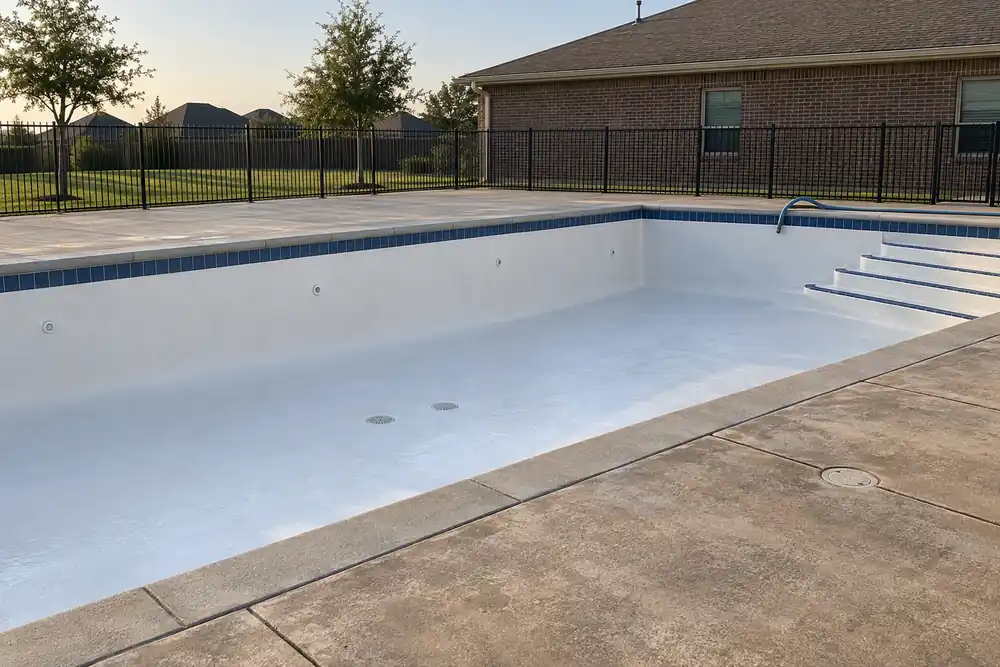
Pool Finishes Compared: Plaster, Quartz, Pebble and Polished
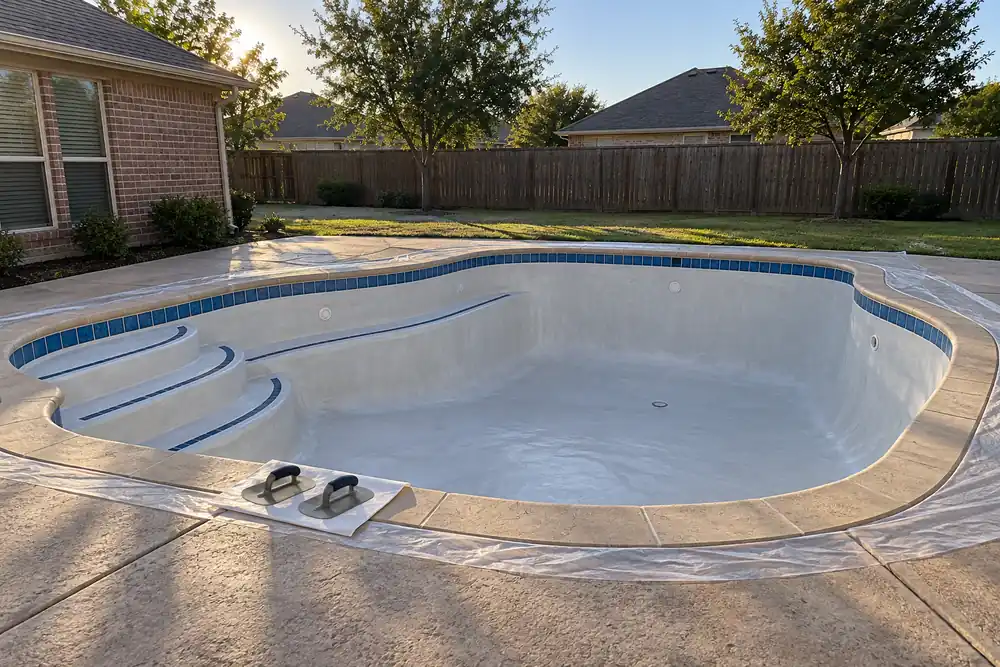
Rockwall Pool Resurfacing compares pool finishes for pools in Rockwall, Texas: white or colored plaster, quartz, pebble and polished finishes all go on as a cement-based coat over the pool's shell, and they differ in how long they last, how they feel underfoot, how they show wear and how much care the water needs.
Standard white plaster is the most affordable of them, the National Plasterers Council says, and in a pool that is well built and well kept, every option on its list can perform reliably for years. The figures below are the Council's and the finish makers' own, each one named. Estimates are free, and we'll talk through which finish fits your pool and how it's used.
Call or request a free estimate any time, 24/7
What each pool finish is made of
The Council's glossary defines a plaster interior finish as cement, aggregate and water, with or without admixtures, mixed, placed and finished as the pool's inside surface, and it notes that interior finishes carry no structural rating: they aren't part of the pool's structure. NPT, a finish maker, says white plaster was the main option when backyard pools spread in the 1950s, and pebble finishes arrived in the 1980s.
White and colored plaster
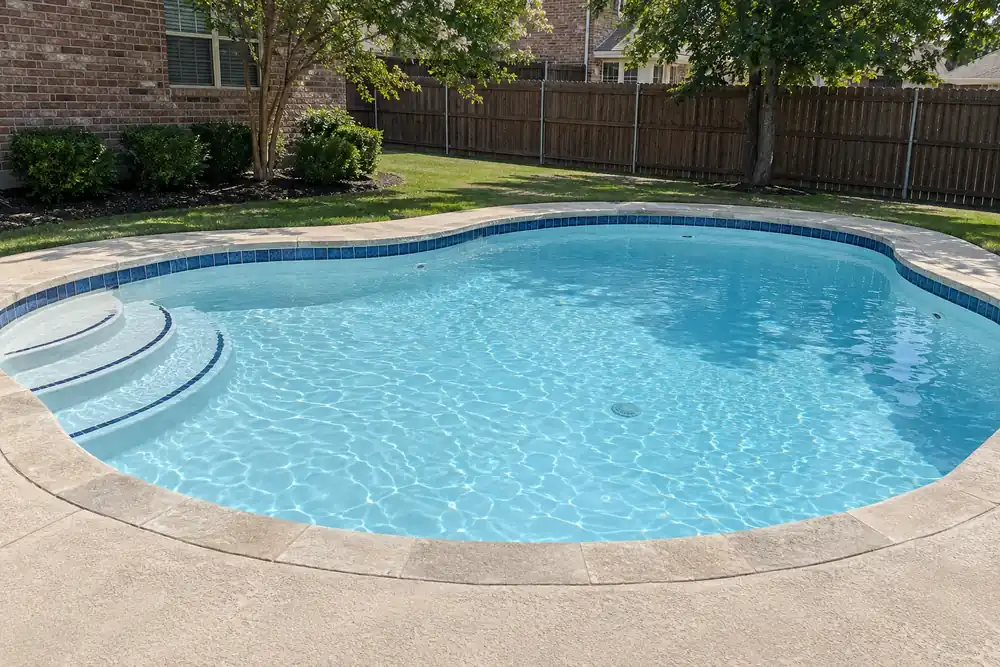
White plaster, which the Council calls "the tried and true" pool and spa surface, is just white cement, white marble aggregate and water; filled, it reads as a brilliant, clean light blue and feels very smooth to the touch. Makers also sell enhanced plasters: Wet Edge Technologies' Altima replaces 35% of the marble sand with hard white quartz and is still hard-troweled rather than textured. White and pigmented plaster are both pool replastering work.
Quartz
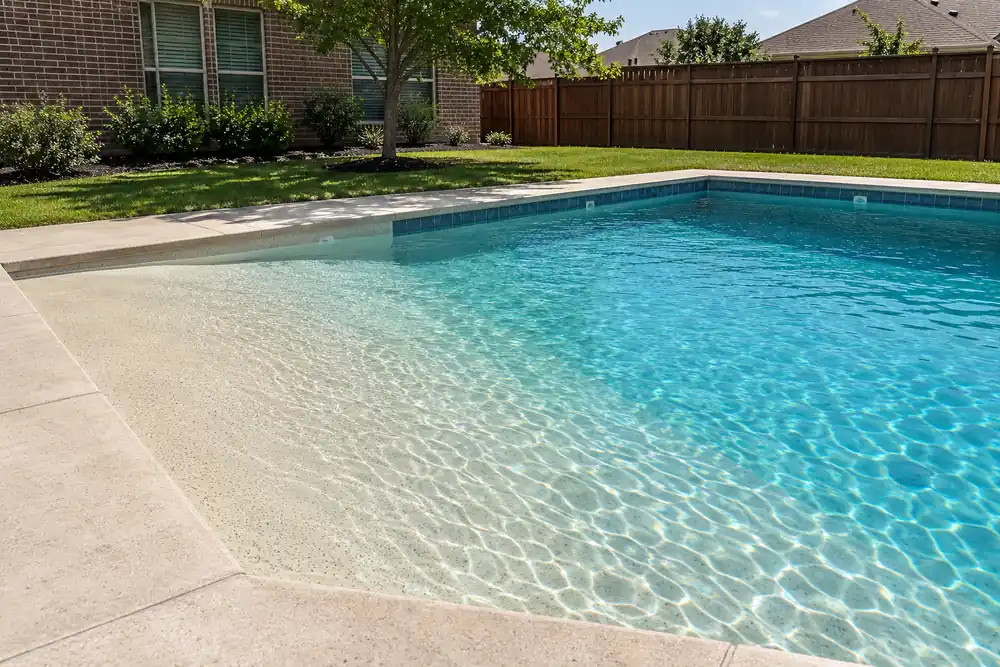
Quartz is a silicate-based mineral aggregate, one of nature's hardest minerals and non-reactive to pool chemicals, in the Council's description; colored quartz is ceramic-coated sand sold in pre-mixed plaster products, which gives a harder surface, far more resistant to swings in water chemistry than standard plaster. NPT goes further and calls natural quartz ten times harder and more durable than marble, its own claim. Diamond Brite, QuartzScapes and Krystalkrete are among the quartz pool finishes.
Pebble
Pebble finishes embed small pebbles, glass and other materials throughout the coat, and the surface is textured once the aggregate is compacted and exposed. The Council calls pebble the most durable surface available because river pebbles are chemically inert, while noting it can still be damaged under the most extreme water chemistry. Pebble Technology International's stones are naturally tumbled, gathered worldwide and screened one by one for a consistent size, the maker says. PebbleTec, StoneScapes and River Rok are among the pebble pool finishes.
Polished and glass bead
A polished finish is smooth but shows the look of exposed aggregate: polishing tools reveal aggregates of varied sizes and colors as the last step of finishing, the Council says. CL Industries says its polished-marble Hydrazzo can be polished back to a uniform luster later without resurfacing. Glass bead finishes are a type of their own in NPT's lineup; its JewelScapes Classic is 100% glass beads with white cement and pigment, applied 3/8 to 5/8 inch thick.
Call or request a free estimate any time, 24/7.
(469) 653-0486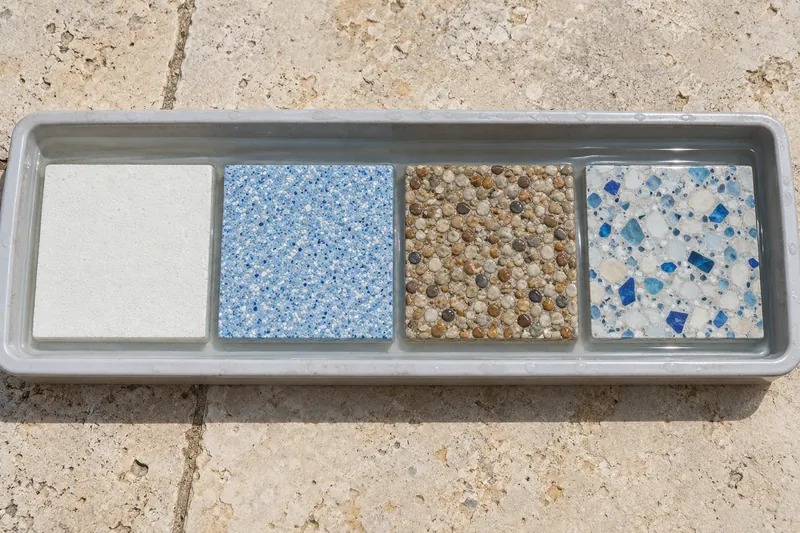
How long each finish lasts, by the sources
The Council's finish comparison rates each type as a surface with a life span and a price tier. Traditional white plaster is a 5 to 8 year surface at the economical end; quartz is a 10 to 15 year surface it calls affordable; polished is an 8 to 12 year surface and pebble a 12 to 18 year surface, both in the upgraded tier.
Other sources stretch or shrink those numbers. For plaster, the Council's owner FAQ allows up to 20 years with proper care and Universal White Cement, a white-cement maker, expects 15 to 20 years or more from good materials, application and water care, yet Pebble Technology International writes of a standard five-year life for most plaster finishes. SGM's own pages can't settle on Diamond Brite, giving it 8 to 12 years in its maintenance guide but 10 to 15 on its product page, and for pebble, Pebble Technology International names no number of years at all: water chemistry, climate and maintenance decide.
Strength varies by blend as well. At 28 days, the makers report 9,913 psi of compressive strength for PebbleTec, 9,000 to 10,000 psi for StoneScapes mixed with NPT's modifier, and 6,310 psi for SGM's River Rok. A warranty term isn't a life span either: Wet Edge Technologies gives warranty terms and says a finish can outlast them with proper care. Behind every figure the Council puts three things together: proper materials, proper workmanship and balanced water.
Call or request a free estimate any time, 24/7.
(469) 653-0486Texture and grip underfoot
Smooth finishes are judged by smoothness: the Council describes hard-troweled plaster as no rougher than very fine, 220-grit sandpaper, like an eggshell, but doesn't want steps, benches or walk-out areas made overly smooth, so feet don't slip. Exposed-aggregate finishes are judged by texture instead, and the trade has set no tolerance for texture, so a textured finish can come out smooth or rough.
Inside each family the aggregate size sets the feel. Pebble Technology International's PebbleTec uses its largest pebbles for a non-slip surface, PebbleSheen slightly smaller ones, and PebbleFina its finely ground smallest, which the maker calls the smoothest texture of any aggregate finish. NPT sells StoneScapes in Micro, its smoothest, Mini and Regular, its biggest pebble. At the polished end, CL Industries describes polished marble as silky smooth yet non-slip, and NPT calls its PolishedScapes its smoothest finish.
Call or request a free estimate any time, 24/7.
(469) 653-0486Color, stains and how finishes show wear
Finishes that leave cement on the surface show the cement's cosmetic quirks. Wet Edge Technologies says quartz and plaster-type finishes are subject to them, with pigmented versions showing more blotchiness, swirling and trowel marks, while exposed-aggregate finishes have the cement removed during installation and are less subject to those issues. The Council adds that mottling is usually more pronounced in darker finishes, and that normal mottling from ongoing hydration typically lessens or disappears with time.
The finish color also tints the water, and the setting changes it again. In NPT's guidance, white, blue and gray pigments make blue water and green, tan, brown, gold or black ones make green water, while shade from trees or buildings deepens it and the shallow end looks lighter than the deep. Black-bottom finishes are strongly affected by everything that changes water color, Wet Edge Technologies says: they can read blue or teal, a dark look may not be possible in a shallow pool, and red, gold, green or brown hardscape or heavy foliage nearby can push the water toward teal or green. Blends with seashells carry a caveat, since Wet Edge and Pebble Technology International both say the shells aren't guaranteed against breaking down or losing color.
Call or request a free estimate any time, 24/7.
(469) 653-0486Water care by finish, and Rockwall's fill water
Every cement-based finish needs balanced water, but the makers don't publish the same ranges. The Council's start-up card keeps the saturation index between 0.0 and +0.3 for ongoing care, and the Council says certain high-performance finishes can tolerate a slightly negative index for short periods. SGM's maintenance guide for Diamond Brite allows -0.3 to +0.3; Pebble Technology International's range for salt-generator pools is -0.3 to 0.3, kept as close to 0.0 as possible; and CL Industries keeps Krystalkrete within ±0.3. For cyanuric acid, the Council's card says 30 to 50 ppm, SGM's warranty 50 to 80 ppm, Pebble Technology International 30 to 80 ppm, and Premix-Marbletite and CL Industries 40 to 60 ppm.
Brushes differ too. SGM says to brush Diamond Brite with nylon, because stainless steel bristles are meant for exposed pebble or unpainted concrete and will mark it; Universal White Cement warns that metal brushes, razor scrapers and aggressive pads can gouge white plaster; and Pebble Technology International still asks for a nylon brush on its pebble finishes.
For the fill, the North Texas Municipal Water District, which supplies the City of Rockwall, calls its treated water "moderately hard," mainly because of minerals in Lavon Lake. The Council sets its fill guideline in calcium hardness, above 200 ppm for most cement-based finishes and above 150 ppm for some high-performance ones, and wants the fill water tested before or right after filling. Rockwall Pool Resurfacing will go over the start-up and water care for whichever finish you choose.
Call or request a free estimate any time, 24/7.
(469) 653-0486Pool finish questions and answers
What are the three most common finishes for concrete pools?
CL Industries, a finish maker, sorts them as plaster, tile or aggregate material laid on top of the pool's concrete shell. Aggregate finishes split further into quartz, pebble and polished blends, and NPT treats glass bead as a type of its own. The National Plasterers Council's comparison covers four cement-based types: traditional white plaster, quartz, polished and pebble.
Can a plaster pool be refinished in quartz, pebble or a polished finish?
Yes; what changes is the preparation each maker asks for. SGM requires its Bond Kote bond coat over the old plaster before Diamond Brite goes on. CL Industries wants any old paint or sealer removed by acid washing or sandblasting before Krystalkrete, allows its PermaKote as a bond coat, and before Hydrazzo wants the pool undercut at least 3 inches around tile, return lines, lights and main drains with an approved scratch coat. Pebble Technology International's remodel process strips the existing surface first. Rockwall Pool Resurfacing talks through that prep at the free estimate.
How can I tell what a finish color will look like in my pool?
Start with the sample: Premix-Marbletite, a finish maker, says a color sample set in 6 inches of water shows roughly how the finish will look. After the work, give it time and the right light. Pebble Technology International asks owners to wait about 28 days before judging the final water and finish colors, and the National Plasterers Council looks at a full, clean pool in the morning, the afternoon or under cloud, since pool lights at night grossly exaggerate imperfections.
Choose your pool finish with a free estimate
Rockwall Pool Resurfacing answers calls and estimate requests 24/7. Tell us the pool's size, its finish now and the look you have in mind.