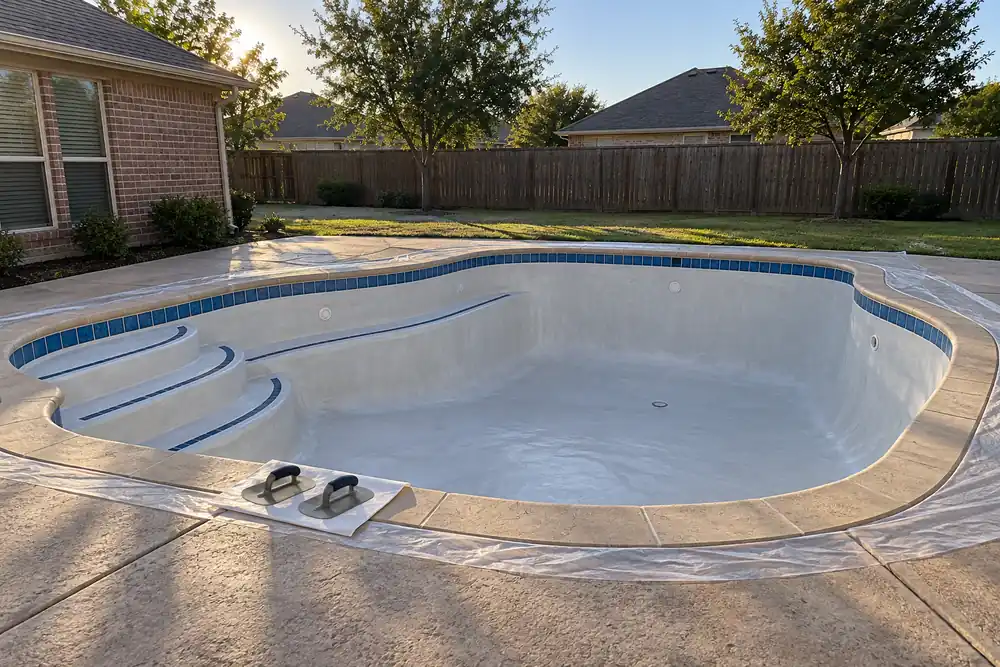
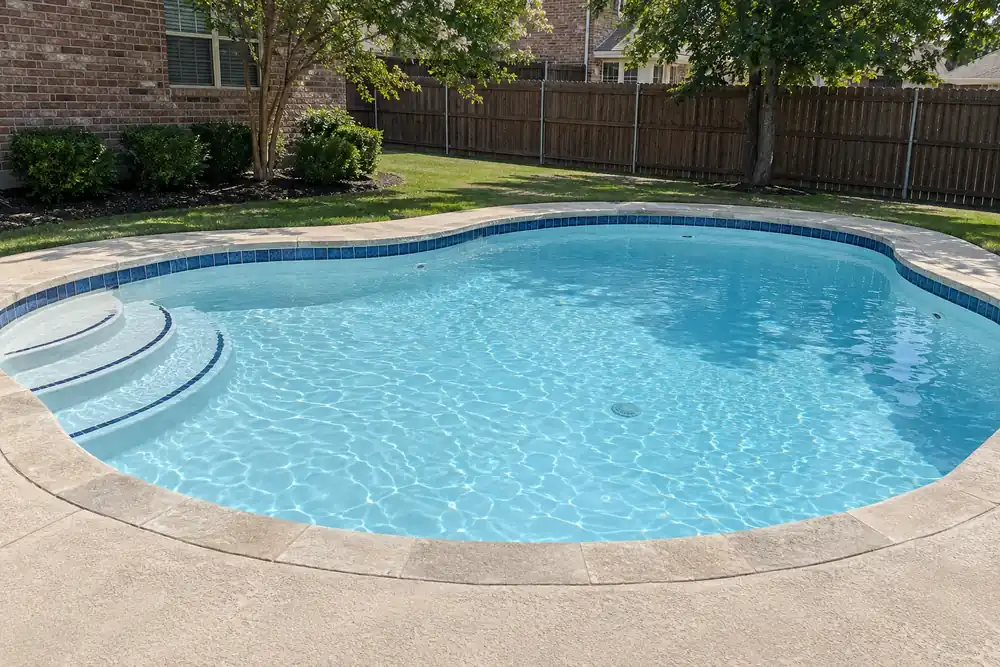
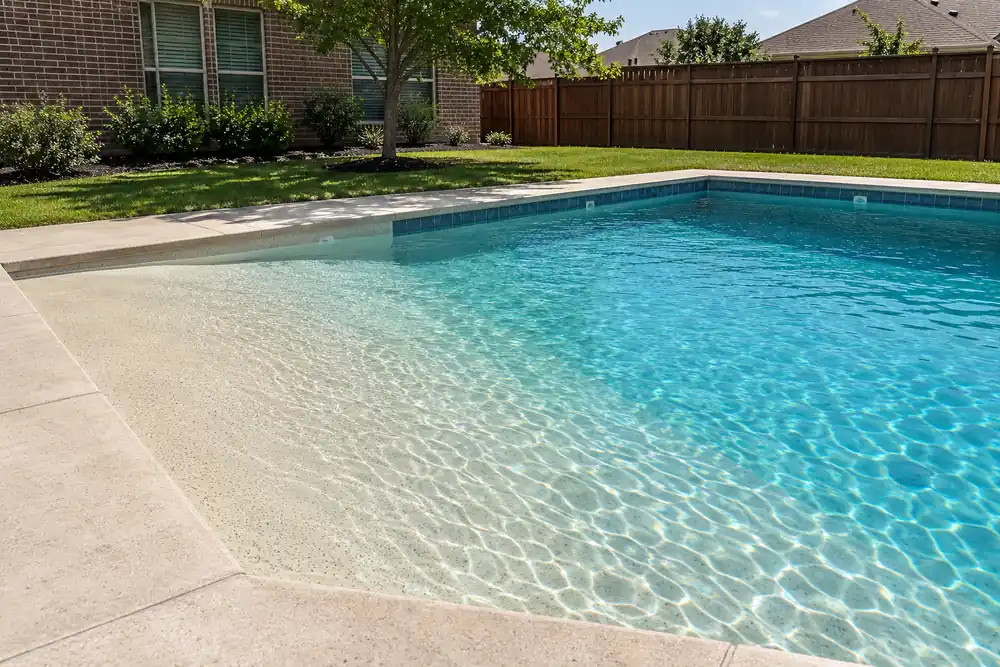
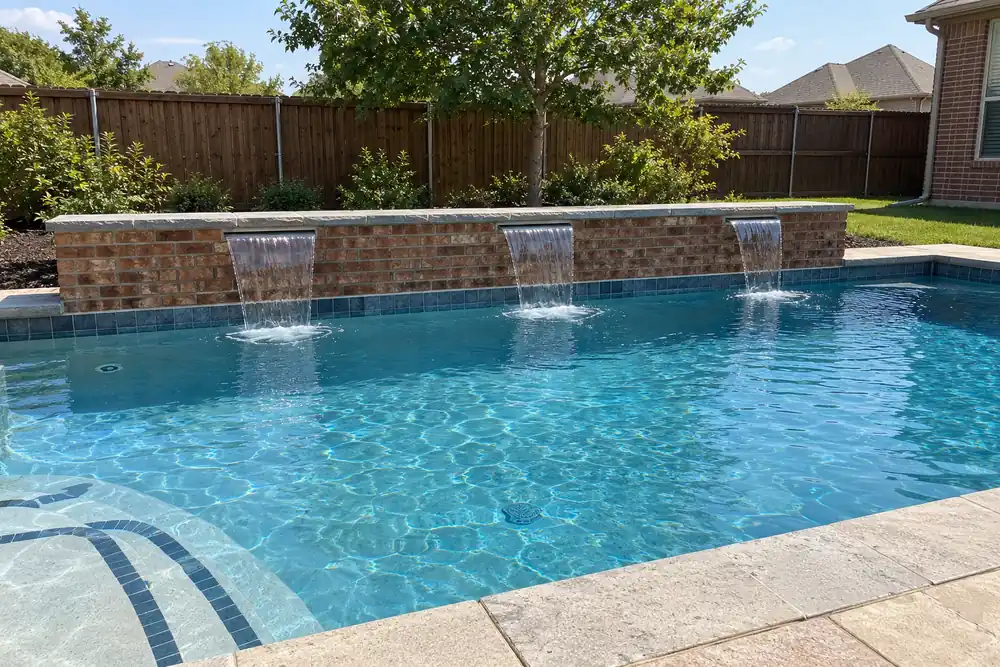
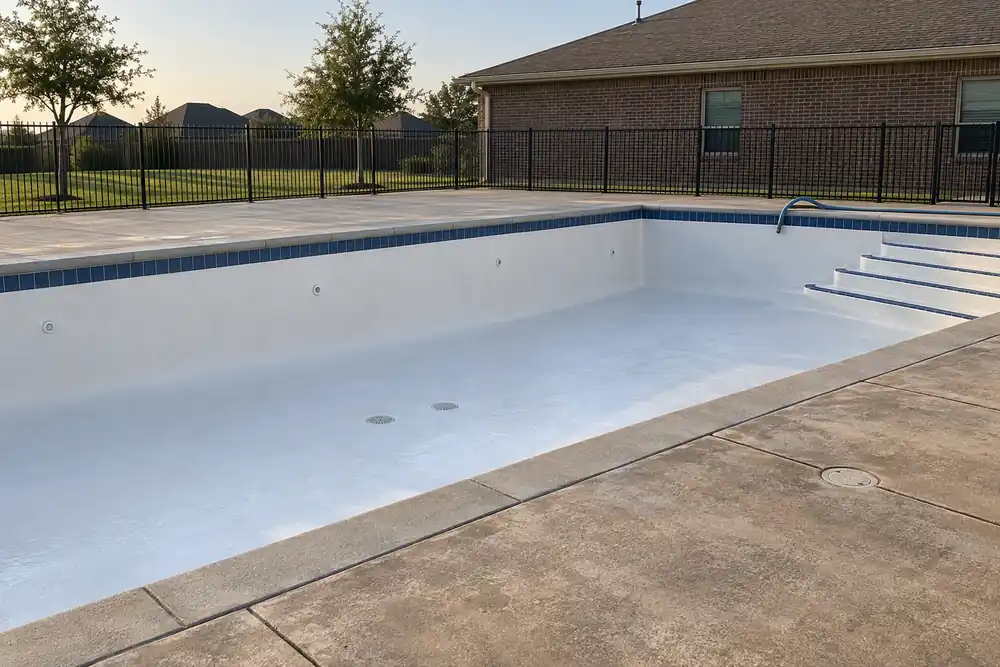
Fiberglass Pool Resurfacing and Repair in Rockwall, TX
Rockwall Pool Resurfacing handles fiberglass pool resurfacing in Rockwall, Texas, and the fiberglass repairs that often come first: buffing out scratches, patching gelcoat cracks and chips, dealing with blisters and stains, and recoating a worn shell with a finish made for pools already in the ground. River Pools, a fiberglass pool maker, describes gelcoat as a colored resin sprayed onto the shell during manufacturing, the smooth, glossy surface you see, touch and walk on.
A fiberglass shell is built to stay full of water, and its makers tie their warranties to who drains it and how, which is why draining comes up before anything else on a fiberglass job. Typical Dallas–Fort Worth prices in 2026 run $8,000 to $15,000 for complete refinishing. Estimates are free, and we'll talk through the drain, the groundwater and the coating before anything is booked.
Call or request a free estimate any time, 24/7
Get free estimates
No charge · answered 24/7
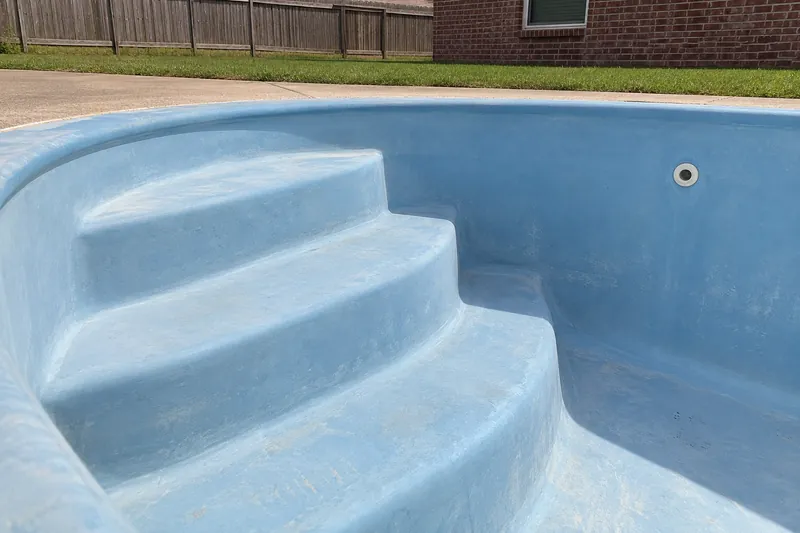
Gelcoat, coatings and paint on a fiberglass pool
River Pools applies its gelcoat in 3 passes to a total of 25 to 30 mils, and warns that too thin a coat can blister from an improper cure while too thick a coat can crack. Latham's fiberglass care manual puts a finished gelcoat at seven to eight times the thickness of a normal coat of paint, which is why most scratches stay superficial.
Why gelcoat isn't resprayed in the backyard
Gelcoat is made to go on in a factory, River Pools says: it takes a long time to dry, must cure at a consistent temperature that would be nearly impossible to hold outdoors, and needs a very precise application. It still suits smaller repairs, but not a whole resurface of a pool in the ground.
Coatings made for pools in the ground
For a full refinish, River Pools points to a coating such as ecoFINISH, a polyethylene powder sprayed with a compressed-air gun and set with heat. The shell may be sandblasted first if paint or residue is stuck to it, a layer of epoxy goes over the whole surface, and the powder is sprayed onto the tacky epoxy in a few heat-cured layers, with a more slip-resistant final layer possible on steps, ledges and entries; it dries almost immediately, so refilling can start the same day. The coating's maker says re-gelcoating limits a pool to light colors such as white, baby blue, tan and light grey, and claims pools and spas finished with its coatings can be heated right after filling. Spa resurfacing covers the spa side.
Epoxy pool paint on fiberglass
Pool paint makers point fiberglass to epoxy. Benjamin Moore recommends only its Insl-x Epoxy Pool Paint for fiberglass shells, scuff-sanded with 150 to 180 grit, while Ramuc abrades bare fiberglass to a #80 grit profile for its epoxies, and Rust-Oleum says its acrylic pool paint must not be used on fiberglass at all. ecoFINISH, which sells a competing coating, argues the paint-to-gelcoat bond stays weak even after sanding. Pool painting covers paint on every kind of pool.
Call or request a free estimate any time, 24/7.
(469) 653-0486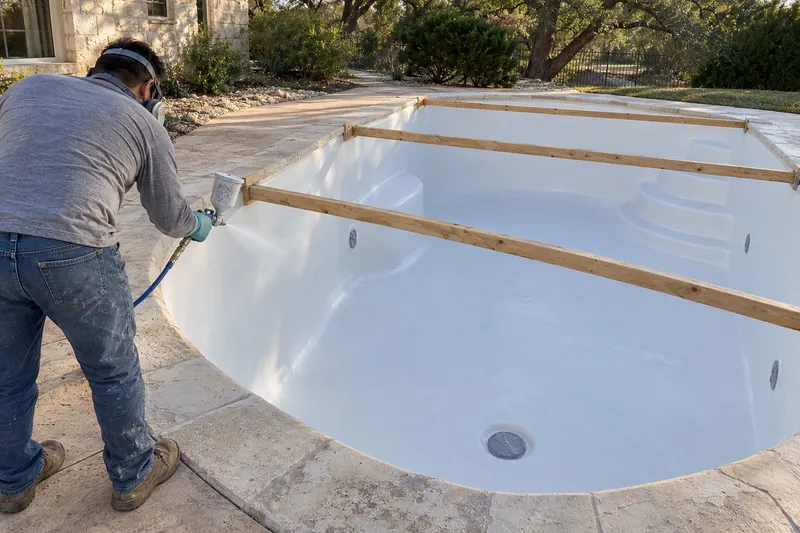
Fiberglass pool repair: scratches, cracks, blisters and stains
Thursday Pools, a fiberglass shell maker, sorts the damage into two kinds: stress on the shell, from installation errors, shifting soil, groundwater pressure, improper draining and severe weather, and wear on the gelcoat, from sharp objects, abrasive cleaning tools and unbalanced water.
Scratches and dull spots
Most scratches are cosmetic and can be buffed out, Thursday Pools says, while deeper scratches, chips and gouges need gelcoat repair. Its method is wet sanding from 1000 grit down through 800 and 600 to 400, never coarser, then back up to a 1000 or 1200 grit finish, with a heavy-cut automotive compound. Latham restores dull spots with a body compound and a fiberglass boat wax, and warns that abrasive cleaners, steel wool, metal scrapers and wire brushes permanently damage gelcoat.
Spider cracks and stress on the shell
Spider cracks are hairline cracks in the gelcoat, usually cosmetic, that form when pressure on the shell goes beyond what the gelcoat can flex, River Pools says. Some of that pressure comes from the ground: sand backfill that becomes saturated can liquefy and press on the walls until they bulge, while gravel stays stable when wet, and leaks around fiberglass pools often come from settling backfill pulling on the pipes rather than from the plumbing itself, a job for pool leak detection and repair. By the NRCS soil map, about half of Rockwall sits on Houston Black clay, which the NRCS rates very limited for houses without basements because it shrinks and swells. A crack that runs into the structure is pool crack repair, not cosmetic work.
Osmotic blisters
Blisters form by osmosis: water passes through the gelcoat, meets contaminants and forms a larger molecule that can't get back out, pushing outward until the gelcoat separates from the layer behind it. River Pools puts a vinyl ester resin layer behind its gelcoat to prevent this, and calls osmotic blisters a cosmetic issue, not a structural one.
Chalking, fading and white stains
ecoFINISH says the sun's UV rays break gelcoat down until it turns chalky, faded and rough, though River Pools says the fading is typically very even and gradual. Irregular white stains below the waterline are a different problem: Tallman Pools ties them to high pH, says they can often be corrected chemically if caught within about 1 to 3 months, and says longer exposure may need professional repair that its warranty doesn't cover.
Call or request a free estimate any time, 24/7.
(469) 653-0486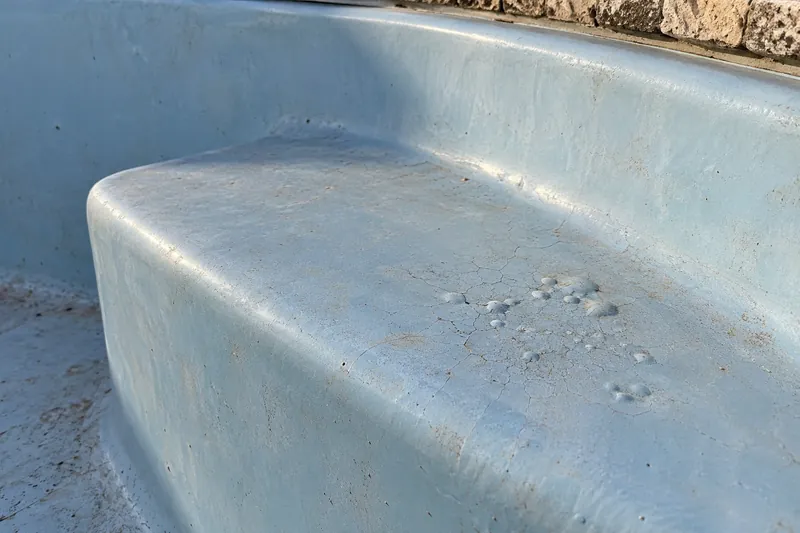
Draining a fiberglass pool for a repair or a recoat
Latham's use and care manual says it in capital letters: draining the pool voids the warranty, because the shell is designed to stay full and will buckle and crack if it is drained without first relieving the groundwater pressure on it. Tallman Pools asks for its written authorization before any draining, and Thursday Pools adds that even lowering the water below the skimmer can void a warranty.
Groundwater, bracing and the floor
The water inside the shell counters the groundwater around it, Thursday Pools explains, and trouble starts when the groundwater outside rises above the water left inside. River Pools' steps for a repair drain are to pick dry weather for the whole drain and refill, check for and remove groundwater around the shell, brace across the pool's width, typically with 3 braces 18 to 24 inches down the side walls, and watch the floor for lifting or a spongy feel as the water comes out. River Pools leaves draining to authorized fiberglass pool professionals.
Rain and drain water in Rockwall
NOAA's Rockwall station averages 4.83 inches of rain in May, its wettest month, and 1.66 inches in August, its driest (1991–2020 normals). Drained water can't simply run to the street: the City lists chlorinated pool draining among its most common storm-water violations, its code allows only dechlorinated water with a pH of 6.5 to 8.5 to reach a storm drain, and its ordinance carries civil penalties of up to $2,000 per violation per day. Under the state's rules, pool drain water may instead be reused on the property, for landscape irrigation for example, without a TCEQ authorization, though the owner is responsible for doing it properly.
Call or request a free estimate any time, 24/7.
(469) 653-0486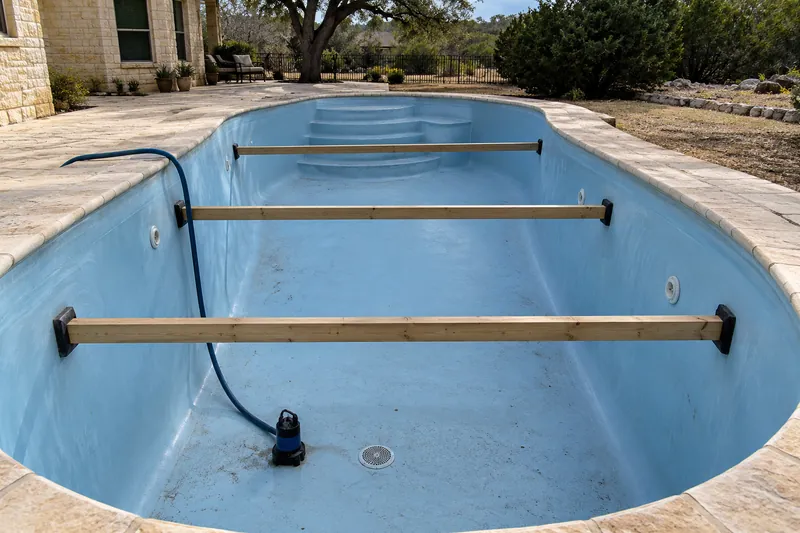
Water chemistry for a fiberglass finish
Fiberglass makers keep calcium far below the 200 ppm minimum the National Plasterers Council builds up to in a new plaster pool. Tallman Pools requires pH 7.2 to 7.4, chlorine 1 to 3 ppm, calcium hardness 80 to 120 ppm and a saturation index (LSI) between −0.30 and +0.30, never above +0.30, and makes a monthly written record of calcium a warranty condition. River Pools and Thursday Pools also keep calcium under 120 ppm, and River Pools warns that high pH plus high calcium damages a fiberglass surface.
Where the makers disagree
Latham's 2026 warranty sets a different band: calcium hardness 250 to 350 ppm, total alkalinity 80 to 120, cyanuric acid 40 to 60 and pH 7.2 to 7.6, tested weekly by a pool professional with the printouts kept. Tallman Pools says there is rarely if ever a reason to add calcium, and warns that calcium hypochlorite causes scaling and that trichlor tablets can bleach or blister the surface, while River Pools lists trichlor tablets among its chlorine options. Each warranty is written around its own maker's numbers.
Rockwall's fill water and summer heat
The City of Rockwall's 2025 water report lists total hardness of 96.0 to 200 ppm and pH up to 8.8, the North Texas Municipal Water District's plant figures, and the district calls its treated water "moderately hard". Heat moves the balance too: Orenda, a pool-chemical maker, explains that warmer water raises the saturation index toward scale-forming, and Rockwall's airport weather station logged 32 days at 100°F or above in 2022.
Call or request a free estimate any time, 24/7.
(469) 653-0486Fiberglass pool resurfacing cost in the Dallas–Fort Worth area
The pool's size, how deep the damage goes and the finish chosen move the price. These are typical Dallas–Fort Worth figures:
- Minor gel-coat touch-ups
- $800–$1,500
- Larger restorations
- $3,000–$8,000
- Complete refinishing
- $8,000–$15,000
- Fiberglass pool repairs, Dallas
- $310–$6,710
Published Dallas–Fort Worth figures for 2026. Averages, not quotes from Rockwall Pool Resurfacing.
National 2026 figures put full fiberglass resurfacing at an average of $6,500 per 1,000 square feet, and a new gel coat with a painted topcoat, enough for minor scratches and dings, at about $1,000 to $1,200. Draining, refilling and treating the water are paid for on top. Rockwall Pool Resurfacing gives a firm price free once it has seen the pool.
Call or request a free estimate any time, 24/7.
(469) 653-0486Fiberglass pool questions and answers
How often does a fiberglass pool need to be resurfaced?
Rarely, by the makers' account. River Pools says that in most cases a fiberglass pool will never need resurfacing, and puts the need for refinishing at 20 or 30 years, unless neglected water chemistry or cleaning wears the gelcoat down sooner. ecoFINISH, which sells refinishing coatings, says most fiberglass pools show wear after 10 to 15 years of regular use. Both are company figures, not measured service lives.
How much does it cost to recoat a fiberglass pool?
National figures from 2025 put a fiberglass resurfacing at $7,000 to $15,000 depending on size and finish, with thermoplastic polymer coatings such as EcoFinish the most popular choice at $10,000 to $15,000 for a medium-sized pool. A gel coat repair of dings, scratches and cracks runs $300 to $400 on the same national basis, before any repainting. Rockwall Pool Resurfacing prices the pool itself, free.
Can you repair a crack in a fiberglass pool?
Usually. Latham calls hairline gelcoat cracks not uncommon and says patch and repair kits come from the authorized dealer, and Thursday Pools says localized gelcoat repairs can often be made without resurfacing the whole pool, though a repair can end up more noticeable than the hairline crack it covers. Solid-color gelcoats are much easier to match than metallic or flake finishes, River Pools says, and Latham's warranty accepts some shade difference after a cosmetic repair. A fiberglass professional can tell whether a crack stops at the gelcoat or reaches the laminate behind it.
What is the downfall of fiberglass pools?
The makers' own guides point to three: the pool has to stay full, so any repair that needs it empty means bracing and groundwater control; the gelcoat is sensitive to water balance, especially high pH with high calcium; and metallic or flake gelcoats are hard to match outside the factory.
Does a fiberglass pool warranty cover the gelcoat?
Usually only for osmotic blisters. Latham covers the surface against osmotic blistering from defects for as long as the original buyer owns the pool, and excludes fading, staining, discoloration and cracking, hairline cracks included; Thursday Pools warrants its surfaces against osmotic blistering for 15 years, and Leisure Pools gives a 10-year gelcoat warranty. River Pools says most makers leave the draining, bracing, refilling and new chemicals to the owner when a gelcoat repair is made under warranty. These are the pool makers' terms, never ours.
Get a free fiberglass pool estimate
Rockwall Pool Resurfacing answers calls and estimate requests 24/7 for fiberglass pool repair and resurfacing in Rockwall and nearby towns. Tell us the pool's maker if you know it, its age and what the surface looks like now.