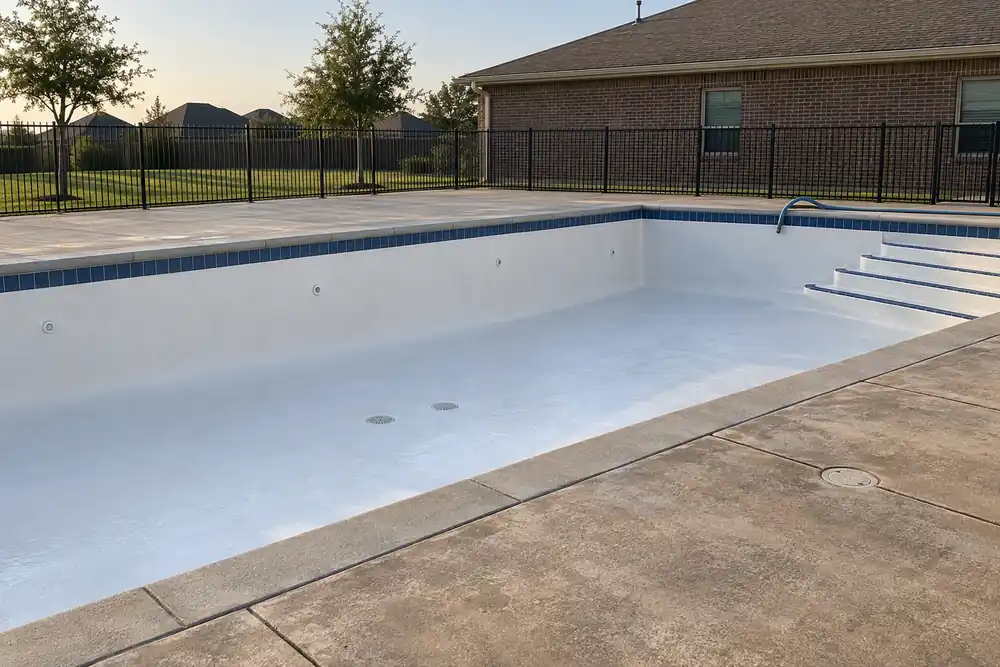
Pool Plaster Repair in Rockwall, TX
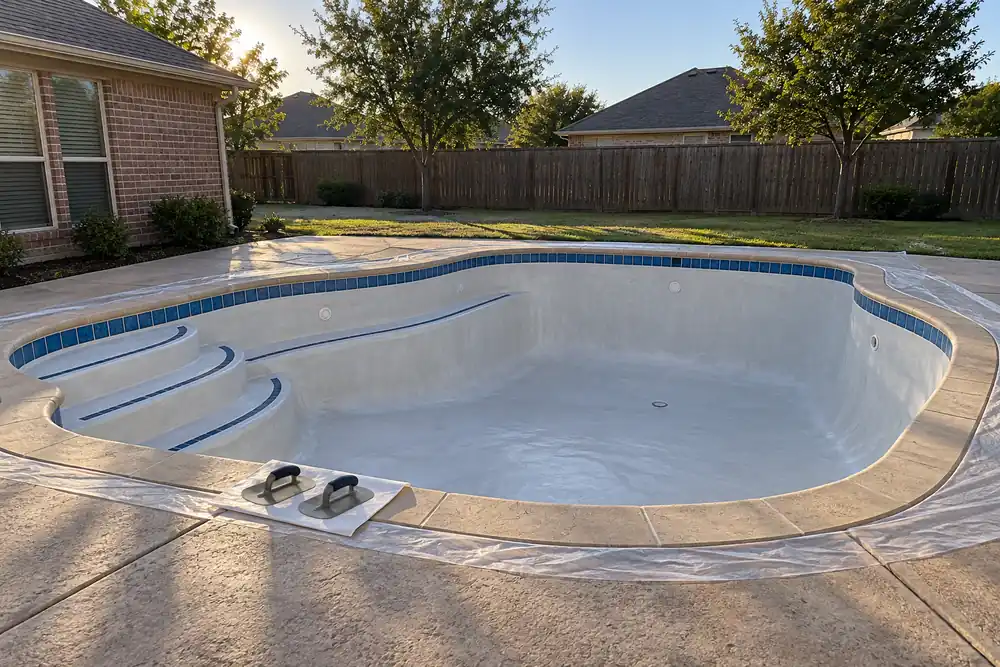
Rockwall Pool Resurfacing handles pool plaster repair in Rockwall, Texas: finding and patching hollow, delaminated and chipped plaster, and treating the etching, scale and stains that wear a finish down before it is due for replacing. The National Plasterers Council says debonding and delamination are not the same thing: debonding is one material separating from another, while delamination is a material separating from itself or from the surface underneath.
Dallas figures for 2026 put the average swimming pool repair at $641, with most jobs between $258 and $1,025, a figure that covers every kind of pool repair. Estimates are free, and we'll sound out the plaster and talk through whether a patch will hold or the pool is due for a new finish.
Call or request a free estimate any time, 24/7
Get free estimates
No charge · answered 24/7
Pool plaster delamination and hollow spots
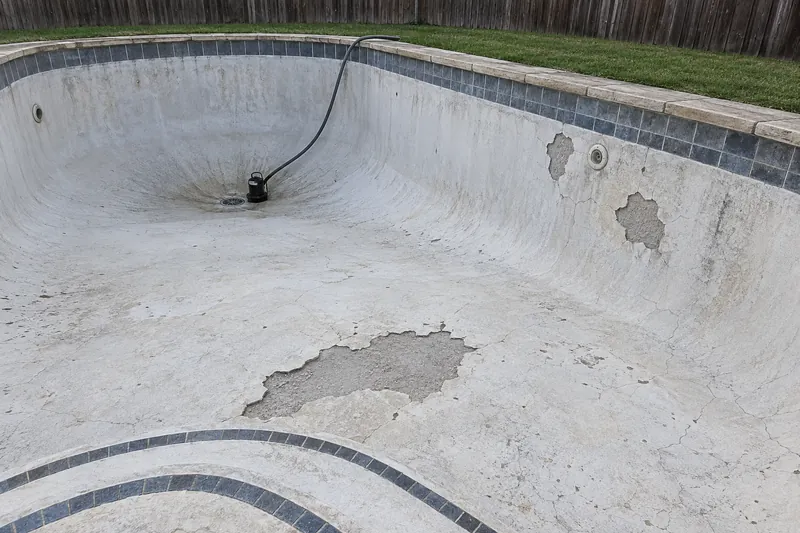
Universal White Cement, a maker of pool plaster cement, calls delamination a bond failure, not a cosmetic flaw: the finish lets go of the gunite or shotcrete shell, or of an earlier plaster layer, and in time that turns into pop-offs, hollow areas and bigger tear-outs. It traces almost every case to what happened before or during plastering, naming poor surface preparation, bond-coat mistakes, cold joints where work stopped and restarted, over-troweling, and thin skim coats stacked over a marginal old finish.
Sounding out the plaster
The test is the sound the surface makes. Universal White Cement taps it in a grid every foot or two with something that won't chip it, such as a screwdriver's plastic handle or a rubber mallet, never metal: plaster well bonded to the shell gives a crisp, tight sound, and delaminated plaster sounds dull, hollow or drum-like. Hollow spots are marked out as they turn up, and a drained pool gives the clearest reading.
Problems that look like delamination
Several don't involve the bond at all. Universal White Cement lists calcium nodules, small mounds or "volcanoes" that ooze calcium; surface spalling, where the top cream layer breaks away from chemistry or freeze-thaw while the plaster beneath stays bonded; etching, which leaves the top few millimeters soft, chalky or pitted; and scaling, a mineral build-up. Its rule of thumb: plaster that doesn't sound hollow and shows no separation at the bond line probably isn't delaminating.
Call or request a free estimate any time, 24/7.
(469) 653-0486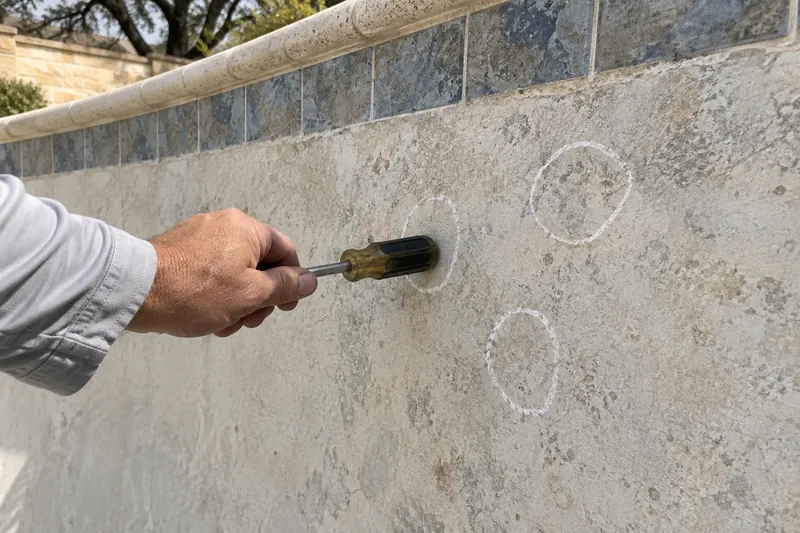
Patching pool plaster or replastering the pool
Universal White Cement draws the line by how far the hollow areas reach. A handful of isolated spots, often around fittings or in corners, can sometimes be chipped out and patched if the rest of the surface is in good condition; hollow areas across several zones or in a repeating pattern point to a bond problem across the pool; and large sections of floor or wall that sound hollow or visibly lift mean a full pool replastering job. It adds that delamination in a young finish signals more serious trouble than in an old one near the end of its life, and that spots actively popping off with sharp edges come first.
Cutting out and filling a patch
E-Z Patch, a maker of pool repair kits, chips the damaged area at least 3/8 inch deep with straight, not beveled, edges, presses its stiff fast-set plaster in firmly and trowels it flush. Its general rules are to remove loose material, clean and roughen the spot, dampen it before any cement repair and keep to each product's minimum thickness. Pool Patch, another kit maker, chips at least 1/4 inch deep for its pebble repair, applies it to a dry surface and mists it with water as it starts to cure to bring the pebble up.
Repairs without draining the pool
Some repairs go in under water. E-Z Patch makes fast-set kits that can be used underwater, so many repairs need no draining, and Atlas Minerals' Epoxybond Pool Putty, a two-part epoxy for concrete and gunite pools, hardens under water as long as the spot is free of loose particles, slime and algae and the putty goes on at least 1/8 inch thick. Anderson Manufacturing's Leakmaster putty hardens white above or below the water in 20 to 60 minutes and is sold for cosmetic repairs. Universal White Cement warns that the voids behind delaminated plaster can become pathways for water, which is where pool leak detection and repair comes in.
Call or request a free estimate any time, 24/7.
(469) 653-0486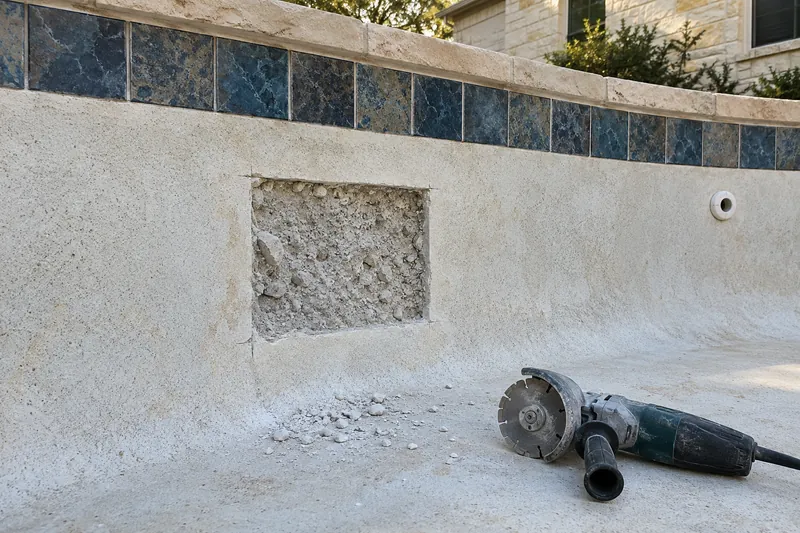
Etching, scale and crazing on pool plaster
Etching and scale
Wet Edge, a finish maker, names scale and spot etching as the most common causes of blotchy or uneven plaster, both often caused by unbalanced water: aggressive water draws pigment out and leaves dull, etched spots, while very high pH, calcium hardness and alkalinity leave rough, blotchy scale deposits. The National Plasterers Council's start-up card ties both to the saturation index: below zero the water causes leaching, etching or discoloration, above it mineral scaling, metal staining or discoloration. E-Z Patch says plaster discolored by minerals left behind as water evaporates can usually be corrected by sanding, an acid wash or both; an acid wash needs the pool drained, which makes it a pool drain and acid wash job.
Crazing and hairline cracks
Universal White Cement separates crazing, fine and shallow check cracks or networks of them within the cement finish itself, from a structural crack, which involves movement or failure in the concrete or shotcrete shell. It lists excess water in the mix, fast moisture loss, hot or windy weather, a thirsty surface underneath, finishing practices and curing conditions among the causes of crazing, and a disclosure endorsed by the National Plasterers Council calls crazing normal, not a defect. A crack through the shell is pool crack repair.
Paint over aging plaster
Paint is another route for worn plaster. Ramuc, a pool-paint maker, calls it a viable option when a plaster finish has aged, roughened and stained to the point where replastering is being considered, but says its coatings are no repair for weak surfaces: aged plaster is checked for hollow or crumbling spots with a ball-peen hammer or similar, and those are repaired before any pool painting.
Call or request a free estimate any time, 24/7.
(469) 653-0486Winter damage and fill water in Rockwall
The National Plasterers Council describes freeze damage to a pool finish in stages: white efflorescence just above the waterline, then a weakened or rough surface or loose aggregate, then a failing cement binder, until thin layers crack, lift, spall or peel. It says the usual repair after a harsh winter is cleaning stains, by an in-water chemical treatment or by an acid wash, and warns that any draining risks damaging the finish. NOAA's storm record shows temperatures at or below 10°F across much of Rockwall County on the morning of January 15, 2024, and wind chills below zero from the night of February 18 to the morning of February 20, 2025.
Rockwall's water is treated at the North Texas Municipal Water District's Wylie plant, and the district's August 2026 data for its Wylie plants give treated water a corrosivity index of -0.02 to +0.26; the district explains that values above zero are scale forming and values below zero more corrosive. Those are plant figures, not pool water.
Northwest of Rockwall, Wylie's median home was built in 2006, by the 2020–2024 American Community Survey, and Rockwall Pool Resurfacing also handles pool plaster repair in Wylie.
Call or request a free estimate any time, 24/7.
(469) 653-0486Pool plaster repair cost in the Dallas–Fort Worth area
We found no published Dallas–Fort Worth price for plaster patching alone, so these Dallas figures cover pool repairs of every kind:
- Average repair, all types
- $641
- Most repair jobs
- $258–$1,025
- In-ground pool repairs
- $365–$2,790
- Repair labor, per hour
- $45–$65
Published Dallas figures for 2026, all repair types. Averages, not quotes from Rockwall Pool Resurfacing.
National figures for 2025 put a small crack in a concrete or gunite pool at $100 to $200, larger cracks, spiderweb cracks, bulges or divots at $700 to $1,000, and surface repairs ahead of a resurface at $200 to $1,200 or more. Rockwall Pool Resurfacing prices a repair free once the plaster has been sounded out.
Call or request a free estimate any time, 24/7.
(469) 653-0486Pool plaster repair questions and answers
Can pool plaster be repaired?
Yes, when the damage is limited. E-Z Patch sells kits for cracks, chips and hollow areas, small or large, on most pool plaster, and says matched, properly cured repairs hold their color well. Universal White Cement adds a caution: where delamination is widespread, patches may not be a long-term fix and more separation can appear later. Rockwall Pool Resurfacing sounds out the whole surface before suggesting a patch.
How soon can a pool be refilled after a plaster patch?
It depends on the product. E-Z Patch's fast-set plaster, used with the water lowered, means the pool may be refilled after 4 hours, with swimming allowed the next day; Pool Patch's pebble repair typically cures in 3 to 4 hours before the pool can be filled. E-Z Patch's general guidance is that repairs typically cure overnight, depending on the product and the temperature, and that the label's instructions come first.
Will a plaster patch match the rest of the pool?
Close, with care. E-Z Patch's method mixes a little of the dry repair material into a putty, wets the old surface and compares the two wet, darkening the mix with black cement dye or lightening it with titanium dioxide until they match; it notes that fast-set material can come out a little lighter. Exact color isn't promised even on a whole new finish: a disclosure endorsed by the National Plasterers Council says finishes aren't guaranteed for evenness of color or exact shade, and should be judged with the pool full and in natural light.
Can I patch pool plaster myself?
Small spots, with a kit and its maker's directions. Two cautions come from the industry: the National Plasterers Council strongly recommends that an owner whose pool is under warranty contact the builder or plasterer before attempting any repair, and SGM tells Diamond Brite owners to call an installer for widespread etching, persistent dark mottling, calcium nodules or any sign of delamination.
What causes stains on pool plaster?
SGM sorts them into two groups. Organic stains come from leaves, berries and algae, and SGM treats them by shocking the pool, brushing and holding free chlorine at the top of its range for 24 to 48 hours. Metal stains run reddish-brown from iron, green to blue from copper, and dark brown or black from manganese; for those SGM uses a metal sequestering agent, lowers the chlorine for a time and applies an ascorbic acid treatment, and it says severe cases benefit from a professional acid wash. Rockwall Pool Resurfacing can look at a stain before anything is drained.
Get a free pool plaster repair estimate
Rockwall Pool Resurfacing answers calls and estimate requests 24/7 for pool plaster repair in Rockwall and nearby towns. Tell us where the plaster is hollow, chipped, rough or stained, and whether the pool is full.