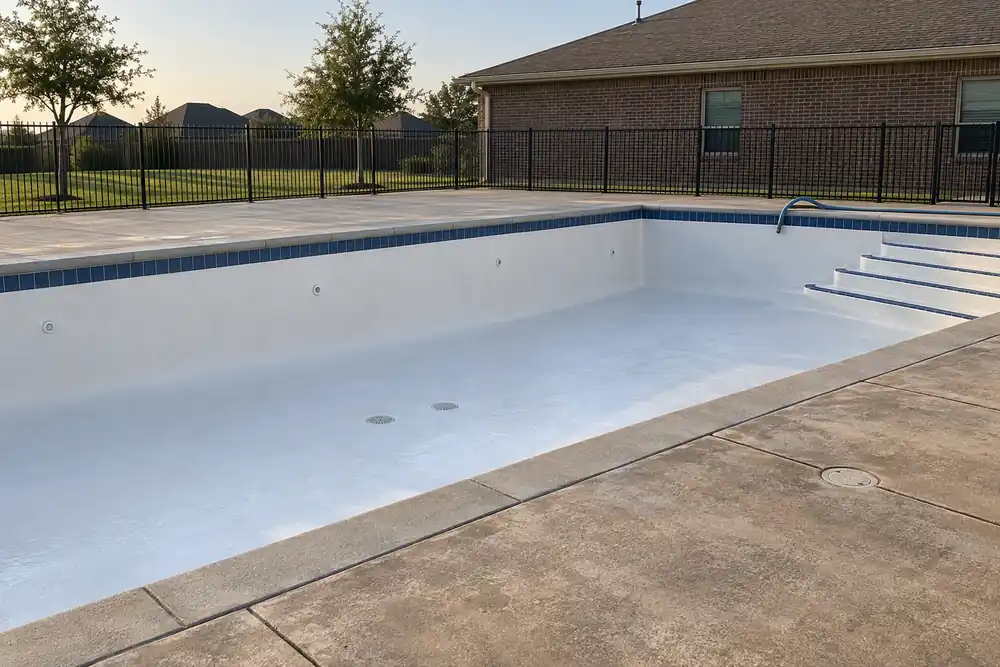
Pool Mastic Replacement in Rockwall, TX
Rockwall Pool Resurfacing handles pool mastic replacement in Rockwall, Texas: cutting the cracked, hardened or pulled-away sealant out of the expansion joint between the pool coping and the deck, setting a new foam backer rod and filling the joint with flexible sealant. The 2021 International Swimming Pool and Spa Code requires the isolation joint where coping meets a concrete deck to be watertight, and that seal is the mastic's job.
Typical Dallas–Fort Worth figures for 2026 put mastic replacement at $7.50 to $13.75 per linear foot, or $750 to $2,300 for a typical residential pool. Estimates are free, and we'll look at the joint's width and depth and what's left of the old sealant before anything is booked.
Call or request a free estimate any time, 24/7
Get free estimates
No charge · answered 24/7
What pool mastic does between the coping and the deck
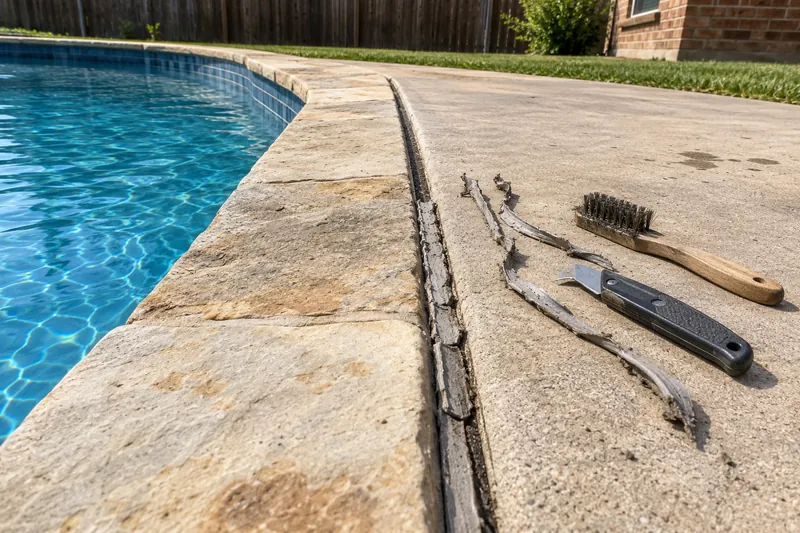
Pool mastic seals an isolation joint. The National Ready Mixed Concrete Association describes isolation, or expansion, joints as the ones that let a slab move independently of walls, footings and other fixed points, and the 2021 code also calls for a joint wherever a deck meets existing concrete work, to protect the pool from damage caused by relative movement.
Why the joint has to stay flexible
A regional sales manager at Marion Ceramics, a brick coping maker, says an open joint should be left between the tail of the coping and the deck and then sealed, because without flexibility there, freeze-thaw can damage the pool. LATICRETE, a tile-setting materials maker, adds that a pool-deck sealant has to ride out freeze-thaw, thermal shock and ultraviolet light and still keep its flexibility.
No sand, grout or mortar in the joint
The same Marion Ceramics manager says mortar can work its way out of coping joints over time, and that some installers pour the deck concrete right up to the coping. Marmiro Stones, a coping supplier, bans sand and polymeric sand from the joint: sand doesn't compress, so it hands the deck's movement on to the coping, and polymeric sand cures to a semi-rigid mass. Where a failed joint has already let coping stones work loose, the fix is pool coping repair; cracked or spalled coping that has to come up is pool coping replacement.
Call or request a free estimate any time, 24/7.
(469) 653-0486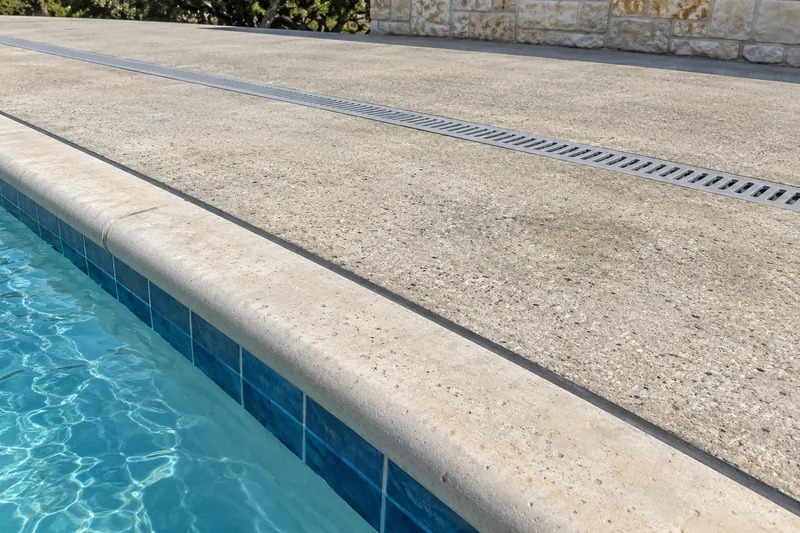
Expansion joint sealants for pool decks
The sealants sold for this joint differ in chemistry, movement rating and how they handle pool water, so the product is matched to the joint.
Self-leveling polyurethane
Sika's Sikaflex-1c SL is a one-part, self-leveling polyurethane for horizontal expansion joints in concrete, rated ASTM C920 Type S, Grade P, Class 25, for movement of ±25%; it is tack-free in 1 to 2 hours and fully cured in 3 to 5 days. Tremco lists swimming pool decks among the uses of its Vulkem Self-Leveling Sealant, which it rates for ±35% joint movement, ready for light traffic at 72 hours and cured in 7 to 10 days for a 1/2-inch bead at 75°F.
Two-part polysulfide
W. R. Meadows' DECK-O-SEAL is a two-part, pourable, self-leveling polysulfide made for pool decks and other moving horizontal concrete, rated ASTM C920 Type M, Grade P, Class 25, and once cured it stretches or compresses up to 25%. The two parts are mixed for at least 10 minutes, because badly mixed sealant leaves soft or liquid spots that have to be dug out and redone. At 77°F and 30% humidity it can be worked for about an hour, sets firm and rubbery within 24 hours and needs at least 24 hours of cure before rain; the maker advises against painting over it.
Chlorine and joints below the waterline
The makers set different limits for pool water. W. R. Meadows says DECK-O-SEAL is not affected by today's pool chemicals but can't be used under water; for pool floors it makes DECK-O-SEAL 125, 25% firmer, and requires its REZI-WELD LV primer on any joint that is submerged, under hydrostatic pressure or over 1 inch wide. Sika caps chlorine exposure for its sealants at 5 ppm and wants a primer and a 1-week cure before Sikaflex-1c SL goes fully under water; its two-part Sikaflex-2c SL handles ±50% movement and needs a 3-day cure first. Tremco rates Vulkem for continuous immersion only in non-chlorinated water.
Call or request a free estimate any time, 24/7.
(469) 653-0486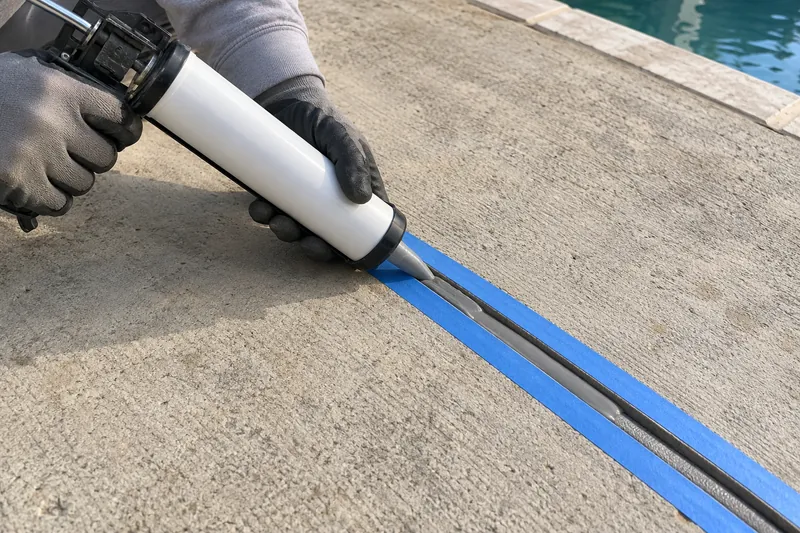
How old pool mastic is cut out and replaced
Cutting out the old sealant
How much comes out depends on the bond. Where the sealant is damaged but still stuck to both sides, W. R. Meadows cuts out only the damaged length and refills it; where the bond has failed, the whole run comes out. Its method runs a knife blade down each side against the concrete, takes off what's left with a wire brush or grinder without marring the deck, and wipes the joint walls with alcohol just before the new sealant goes in, and it warns that its own sealant's chemical resistance can make it very difficult to remove. Marmiro Stones clears old caulk, dirt and loose material with a razor knife and wire brush and lets the joint dry completely.
Backer rod, width and depth
The backer rod controls the depth. LATICRETE says it keeps the sealant bonded to the joint's two side walls only, where sealants perform best, puts typical sealant depth at half the joint's width, and rates closed-cell polyethylene rod best for wet and submerged joints. W. R. Meadows keeps a 2:1 width-to-depth ratio with the sealant never less than 1/4 inch or more than 1/2 inch deep, won't put DECK-O-SEAL in a joint under 1/4 inch wide, and fills larger joints first with a non-asphalt filler such as cork. Marmiro Stones sets its rod about 3/8 inch below the surface, fills 1/4 to 3/8 inch deep with pool-grade elastomeric caulk, and pulls the edge tape before the sealant skins over.
Dry joints, cured concrete and the weather
W. R. Meadows wants the joint clean and dry, free of dust, dirt and laitance, in fully cured concrete (it cites 28 days as the industry standard), with 2-inch masking tape on both sides, and it recommends its primer for the best adhesion and for joints over 1 inch wide. Marmiro Stones waits at least 30 days after a new concrete deck is poured before caulking it. Sika pours between 40°F and 100°F, ideally when the joint sits at the midpoint of its designed movement; Rockwall's airport weather station recorded 32 days at 100°F or above in 2022 and 38 in 2023, topping out at 108°F on August 18, 2023.
Call or request a free estimate any time, 24/7.
(469) 653-0486Rockwall's clay, freezes and the coping joint
About half of Rockwall sits on Houston Black clay, and the NRCS gives Heiden and Ferris, the city's other main clays, high shrink-swell potential and cracks 1/2 to 3 inches wide at a foot deep or more in dry periods. NOAA's storm record for Rockwall County shows temperatures at or below 10°F across much of the county on the morning of January 15, 2024, and up to 1.6 inches of sleet and snow on January 24–25, 2026.
A slab that has sunk or tipped away from the coping is a pool deck lifting job, and a worn or cracked deck surface is pool deck resurfacing work; the coping joint can be planned in with either.
Northeast of Rockwall, Houston Black clay on 1 to 3 percent slopes covers 68.7% of Fate's mapped area by the NRCS soil map, and Rockwall Pool Resurfacing also handles pool mastic replacement in Fate.
Call or request a free estimate any time, 24/7.
(469) 653-0486Pool mastic replacement cost in the Dallas–Fort Worth area
Joint width, depth, condition and access set the per-foot price. These are typical Dallas–Fort Worth figures:
- Most jobs, per linear ft
- $7.50–$13.75
- Typical residential pool, full joint
- $750–$2,300
- Basic service, per linear ft
- $7.50–$9.50
- Premium service, per linear ft
- $11–$13.75
- Complex projects, per linear ft
- $13.75–$18
- A second Dallas range, per linear ft
- $8–$15
Published Dallas–Fort Worth figures for 2026. Averages, not quotes from Rockwall Pool Resurfacing.
Rockwall Pool Resurfacing measures the joint's length and width before pricing it, and the estimate is free.
Call or request a free estimate any time, 24/7.
(469) 653-0486Pool mastic replacement questions and answers
What is mastic on a pool?
It's the flexible sealant in a pool's expansion joints, above all the one between the coping and the deck. MAPEI's pool construction detail shows a flexible sealant over a closed-cell foam backer rod where the tile and coping meet the decking, and bond breaker tape under more flexible sealant where the tile meets the plaster finish.
What does pool mastic do?
It keeps water out of the joint while the deck and the pool wall move by different amounts. That is how the Interlocking Concrete Pavement Institute explains the urethane or neoprene sealant and backer rod it places between a paver deck and the coping, a detail it calls typical of pool construction. On a concrete deck, the 2021 code asks that the coping joint be built so the deck's expected movement can't damage the coping or its mortar bed.
How much does it cost to replace the mastic in a swimming pool?
Nationally, professional mastic replacement averaged $5 to $15 per linear foot in 2024 figures, covering removal of the old mastic, cleaning the joints and applying the new, which comes to $500 to $1,500 for a pool with about 100 feet of perimeter. Rockwall Pool Resurfacing gives a firm figure once the joint has been measured.
How to replace mastic around pool?
Cut the old sealant out, clean and dry the joint, set a backer rod to the depth the sealant needs, tape the edges, then pour or gun in the new sealant and keep traffic and rain off it while it cures. Joints below the waterline are a different matter: W. R. Meadows strongly recommends a contractor trained in joint sealing for them and says homeowners should not attempt them.
How long does pool mastic last?
Marmiro Stones, a coping supplier, says most elastomeric caulks last five to ten years; that is a general figure, not a sealant maker's rating. Its guideline is to inspect the joint every year and to repair or replace the caulk whenever it cracks, pulls away or deteriorates, keeping the joint clear of dirt, plants and standing water.
Get a free pool mastic replacement estimate
Rockwall Pool Resurfacing answers calls and estimate requests 24/7 for pool mastic and expansion joint work in Rockwall and nearby towns. Tell us roughly how far the joint runs around the pool and where the old sealant has cracked or pulled away.