Pool Leak Detection and Repair in Rockwall, TX
Rockwall Pool Resurfacing handles pool leak detection and repair in Rockwall, Texas: confirming that a pool is really losing water, tracing the leak to the shell, a fitting or a buried pipe with dye, listening gear and pressure tests, and sealing it. The U.S. Environmental Protection Agency's pool guide warns that leaks can go unnoticed for long periods, and that small ones can quickly turn into big ones.
Typical Dallas–Fort Worth figures for 2026 put professional leak detection at $350 to $600, depending on how complex the pool is. Estimates are free, and we'll talk through what you've noticed, from a falling water line to wet spots on the deck, before anything is booked.
Call or request a free estimate any time, 24/7
Get free estimates
No charge · answered 24/7
How pool leak detection works
Leak detection narrows the search by elimination. Anderson Manufacturing, a maker of leak-detection equipment, says every plumbing line should be pressure tested, whatever the suspected spot, to settle whether the leak is in the plumbing or in the pool's shell.
Evaporation or a leak
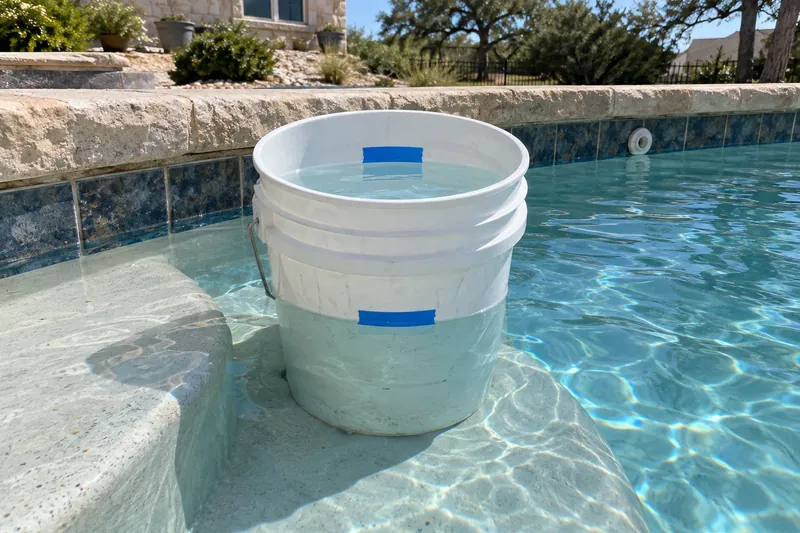
The EPA's first check is a 24-hour bucket test that sets the pool's water loss against a bucket's on a step; a pool that loses more than the bucket may have a leak. Beyond the water line, it counts wet spots around the pool and air bubbles in the return line or the pump strainer among the signs.
Dye tests, diving and listening
Anderson uses dye to make water flow visible, releasing a little near skimmers, return fittings, lights, cracks, main drains and hydrostatic valves to see whether the pool pulls it out. The bottom may call for diving gear, and in concrete pools a hydrophone, an underwater microphone, checks spots that can't otherwise be reached without diving. LeakTronics, another equipment maker, starts by listening at the return fittings and with a static pipe test: the returns are closed with cane plugs, one of them with a pinhole, and dye shows whether the pipe is drawing water in.
Pressure tests on the plumbing
In Anderson's method, closed test plugs block every opening in a section of plumbing but one, water is pumped in through a pressure tester to no more than 20 psi, and a drop in pressure shows a leak, while a line that holds can be crossed off. It uses water because water doesn't compress, which gives quicker, more accurate results, and it warns that tapered winterizing plugs tend to pop out at test pressure. LeakTronics brings lines up slowly to 15 psi and never past 20, since higher pressure can damage pool plumbing, and keeps pressure testing as a last resort because it can mean cutting pipe at the equipment.
Pinpointing a buried pipe
For underground plumbing, Anderson's answer is sonic location: the line is purged of water, air goes in at no more than 20 psi, 5 to 10 often being enough, and bubbles out of the leak into the wet soil, where a listening device moved along the pipe's route finds the loudest sound, most often right above the leak.
Call or request a free estimate any time, 24/7.
(469) 653-0486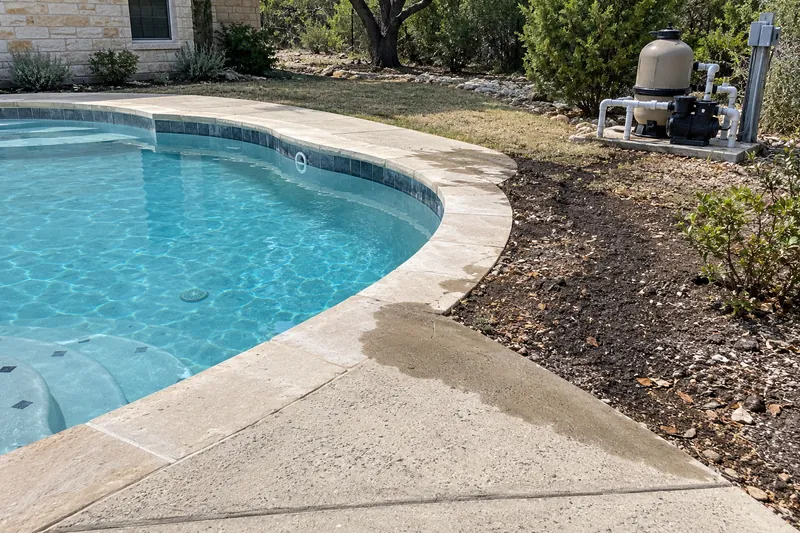
Where pools leak and how the leaks are sealed
The National Plasterers Council wants a finish placed so the pool is watertight, with no open cracks, holes or gaps at the tile line, rockwork or other transitions and a tight seal around plumbing and light fixtures. Shotcrete and plaster are semi-permeable, it explains, letting water vapor through over time but not free liquid water.
The tile line, cracks and the finish
Gaps and loose tile at the water line are pool tile repair work. A crack through the concrete shell calls for pool crack repair, and where water is finding its way behind hollow, delaminated plaster, the finish itself needs pool plaster repair.
Plugging running water
SGM's Instant Hydraulic Cement, Portland cement with additives made for underwater patching, is mixed about three parts powder to one part water, only as much as can be used in three to five minutes, and pressed into a leak for at least five minutes or until it has set. Xypex's Patch'n Plug is another fast-setting hydraulic cement, which the maker says stops flowing water in seconds and seals cracks, tie holes and other defects in concrete.
Pipes under the deck
For new or altered circulation piping, the 2021 pool code that Rockwall has adopted requires a hydrostatic test at 25 psi held for at least 15 minutes and bars compressed air from tests on plastic water piping, and parts of an existing system that are repaired or altered must be tested as the code prescribes. Anderson points out that the tests run to pass a city inspection of new plumbing differ from those used to hunt leaks in existing plumbing.
Water pressing in from outside
Water can also push in from outside. The National Plasterers Council warns that water shouldn't be allowed to gather against the outside of a pool shell, because back pressure from even a seasonal rain or a leaking irrigation pipe can make a waterproofing membrane, bond coat or interior finish debond. We'll talk through the yard's drainage as well as the pool.
Call or request a free estimate any time, 24/7.
(469) 653-0486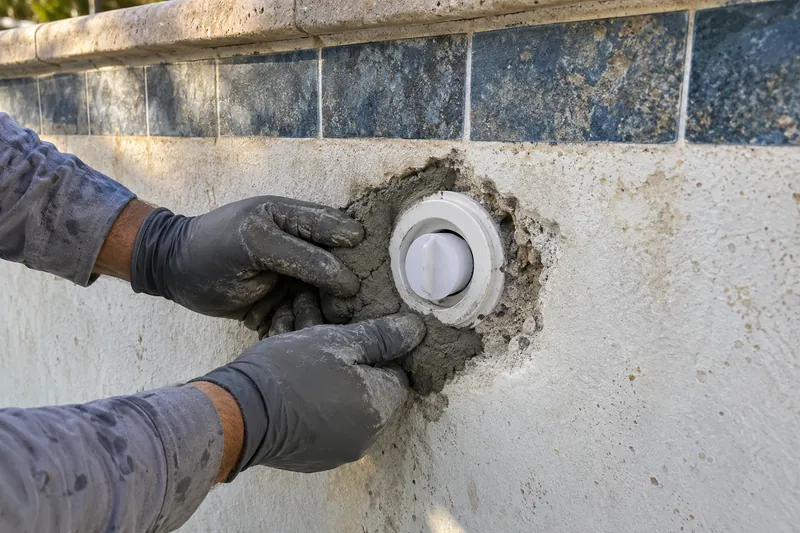
Water loss and City water rules in Rockwall
Rockwall's code requires every water customer to keep service pipes and connected fixtures in good repair to prevent waste, and lets the City shut off water being wasted through neglected fixtures if the customer refuses to repair them after notice; excess runoff and other obvious waste are water-waste offenses in their own right.
What lost water costs
Water to top a pool back up bills at the City's residential rates, set by Resolution No. 25-13 from January 1, 2026: $4.40 per 1,000 gallons from 2,001 to 8,000 gallons a month, $5.45 from 8,001 to 16,000 gallons and $7.47 above 16,000.
Topping up in a drought
Even in Stage 3, the strictest stage of Rockwall's drought plan, existing pools may add water to replace losses from normal use and evaporation. As of October 4, 2026, no drought stage was named on the City's official pages; check the current stage with the City before a big refill.
Call or request a free estimate any time, 24/7.
(469) 653-0486Pool leak detection and repair cost in the Dallas–Fort Worth area
Detection and the repair are priced as separate items in the figures below; what the leak turns out to be, and how deep and reachable the pipe is, move the repair price. These are typical Dallas–Fort Worth figures:
- Professional leak detection (Dallas)
- $105–$520
- Leak repair, all types (Dallas)
- $15–$3,610
- Seal repairs: fittings, returns and light niches
- $350–$2,750
- Broken pipe under the concrete deck
- $850–$3,500
- Skimmer replacement, per skimmer
- $1,850–$3,200
- Spillway, waterfall or spa-overflow leak
- $500–$2,500
Published Dallas–Fort Worth figures for 2026. Averages, not quotes from Rockwall Pool Resurfacing.
Nationally, a pool line pressure test costs $200 to $500, and digging to reach a buried leak can run from $500 up to $5,000 for larger, harder-to-reach areas, in 2026 figures. Rockwall Pool Resurfacing gives a free estimate once it knows what the pool is doing.
Call or request a free estimate any time, 24/7.
(469) 653-0486Pool leak detection questions and answers
What is the most common area for pool leaks?
The EPA's list runs from the liner and the pump seal to the piping and its joints, the connection where pipe meets pool, and the pool's edges. LeakTronics claims that 95% of pool leaks happen within 3 feet of the pool, a maker's figure with no study cited, and Anderson calls the gap that opens between a skimmer's throat and the pool shell a common structural leak.
Can you fix a pool leak without draining?
Some leaks can be fixed with the water lowered or left in. For the skimmer-throat leak, Anderson lowers the water below the skimmer opening and injects expanding urethane foam through a hole drilled in the bottom of the throat to fill the void behind it, an alternative to putty that has to be redone every year or a full skimmer replacement. E-Z Patch says its clear sealant, E-Z Patch 28, works underwater as well as above it and suits leaks at plastic skimmers and light fixtures. A crack injected to its full depth is different: that needs the pool drained.
How much does it cost to fix a leak in an inground pool?
National 2025 figures put an in-ground pool leak repair at $350 to $2,700, plus the cost of draining, refilling and treating the water, and note that minor patches are sometimes included in the detection price while major repairs get a separate bid. In 2025 Dallas–Fort Worth figures, detection and repair together ran $400 to $1,200.
How much water does a pool lose to evaporation?
A lot, before any leak. The EPA estimates that an uncovered 500-square-foot pool can lose 12,000 to 31,000 gallons a year to evaporation, depending on climate, and says a solid cover can cut evaporation by more than 90 percent while it is on. Summers here are hot: as of September 22, 2026, the National Weather Service counted 52 days at 100°F or above at DFW for the year, tied for fifth-most on record.
Does a pool leak have to be fixed before resurfacing?
The finish makers say so. SGM wants any water seeping through the shell under groundwater pressure, which SGM calls weepers, stopped before plastering, using its hydraulic cement to plug leaks and seal around fittings, and its bond coat instructions flag pools that are below the water table or leaking for special attention. Rockwall Pool Resurfacing can check for a leak before a new finish is planned.
Get a free pool leak detection estimate
Rockwall Pool Resurfacing answers calls and estimate requests 24/7 for pool leak detection and repair in Rockwall and nearby towns. Tell us how fast the water is dropping and anything you have spotted, such as wet ground or bubbles at the returns.