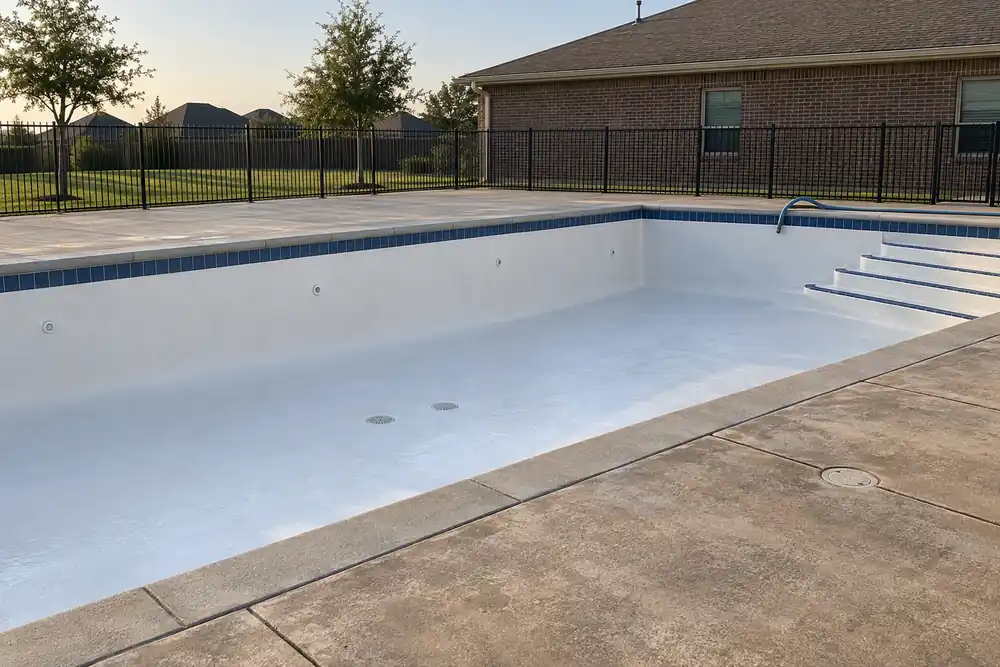
Pool Painting in Rockwall, TX
Rockwall Pool Resurfacing handles pool painting in Rockwall, Texas: epoxy, acrylic and rubber-based pool paint on concrete and plaster pools, matched to the coating already on the pool, after the old surface is cleaned, repaired and etched or sanded. Benjamin Moore's Insl-x epoxy, for one, is a two-component polyamide epoxy mixed 1 to 1, made for properly prepared concrete, plaster, fiberglass, steel and previously epoxy-coated pools.
Typical Dallas–Fort Worth figures for 2026 put repainting at $1,547 per 1,000 square feet. The estimate is free, and we'll talk through which paint can go over the one on your pool before anything is booked.
Call or request a free estimate any time, 24/7
Get free estimates
No charge · answered 24/7
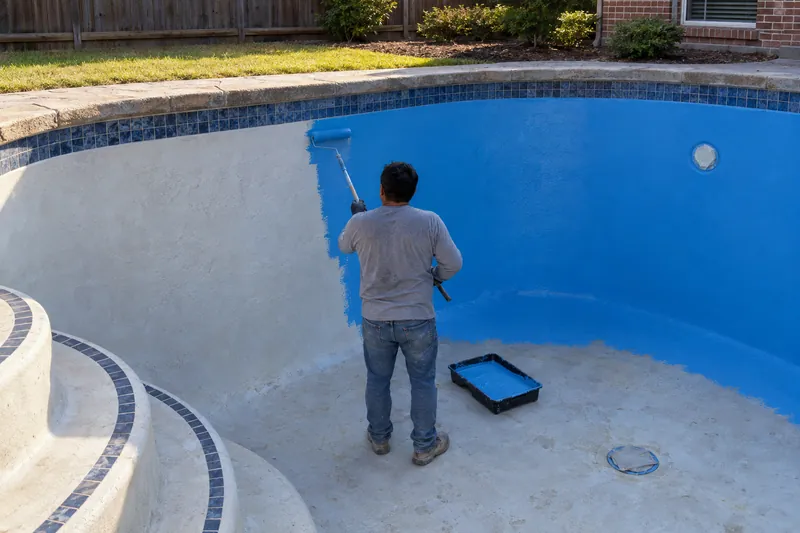
Epoxy, acrylic and rubber-based pool paint
Benjamin Moore designs all four of its pool paints for public and residential pools, but says public pools tend to run higher chlorine, which makes its epoxy or chlorinated rubber the better choice there for their higher chemical resistance.
Epoxy pool paint
Benjamin Moore's data sheet gives its epoxy a spread of 350 to 400 square feet per gallon, a film of 2.5 to 2.8 mils dry, recoating within 3 to 72 hours and a full cure of 7 days outdoors. Ramuc's Hi Build Epoxy builds up to 8 mils dry per coat, which Ramuc says smooths rough surfaces. Every epoxy chalks and fades in sunlight over time; Rust-Oleum calls that change cosmetic only, with no harm to the film's integrity or performance, and adds that epoxy coatings yellow with age.
Waterborne acrylic
Benjamin Moore's waterborne acrylic can go over most pool coatings in good condition, or over bare concrete or plaster, and onto slightly damp surfaces; it recoats in 4 to 6 hours. It isn't for aluminum, stainless steel, galvanized, fiberglass, steel or vinyl-lined pools, or for painting in direct sun or with rain forecast within 3 days. Rust-Oleum says its acrylic can and should go on damp surfaces and is safe over earlier chlorinated and synthetic rubber paint.
Rubber-based paint
Benjamin Moore's synthetic rubber paint is for concrete pools and goes only over earlier rubber-based or chlorinated rubber paint, at 400 to 500 square feet per gallon with 12 to 24 hours before recoating. Its chlorinated rubber line isn't sold in many areas because of limits on solvent emissions (VOCs), and Ramuc suggests moving from traditional chlorinated rubber to the newer synthetic rubber paints. Fiberglass shells have their own paint rules, covered under fiberglass pool resurfacing.
Call or request a free estimate any time, 24/7.
(469) 653-0486Which pool paint can go over the old paint
Kelley Technical Coatings, which makes Olympic pool paints, recommends recoating with the same type of coating already on the pool, and identifies it with a chip test: a chip that dissolves in denatured alcohol is water-based acrylic, one that dissolves in its mineral-spirits blend is synthetic rubber, one that dissolves only in straight solvent is chlorinated rubber, and one that doesn't dissolve at all is epoxy. Synthetic rubber can go over chlorinated rubber, but not the other way round.
Epoxy over epoxy only
Benjamin Moore puts its epoxy over old paint only when that paint was also a 2-part epoxy, scuff-sanded with 100 to 150 grit, and never acid-etches a previously coated surface. Rust-Oleum's epoxy pool paint must not go over chlorinated rubber, synthetic rubber, vinyl or acrylic, and Kelley says never to recoat rubber-base coating with an epoxy, and not to recoat old epoxy until it has worn so thin it is almost transparent.
When the old paint has to come off
Kelley never recoats a pool that is scaling, peeling or blistering: a few small spots can be sanded and primed, otherwise all the coating comes off. Benjamin Moore suggests stripping back to the base once 4 or more layers of paint have built up and aged. Going from paint back to a cement finish means taking the paint off too: CL Industries requires previously applied paints or sealers to be removed by acid washing or sandblasting before its quartz finish goes on; the cement-based options start with pool replastering.
Call or request a free estimate any time, 24/7.
(469) 653-0486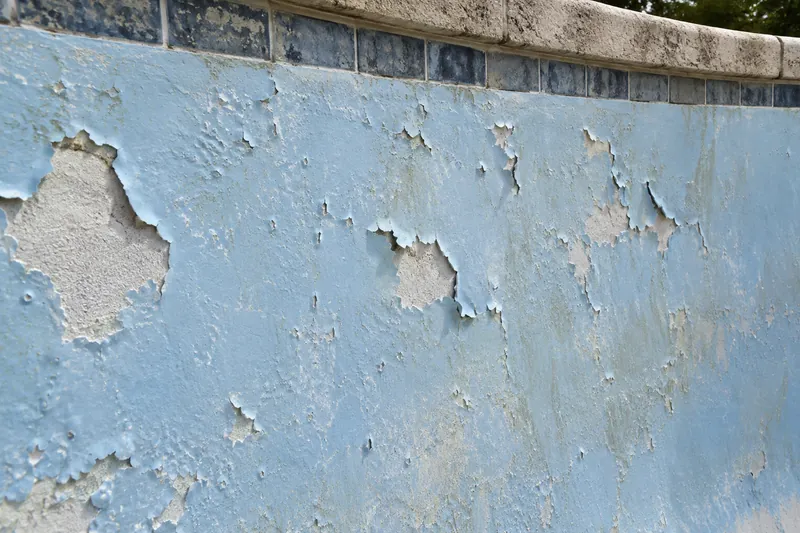
Preparing a concrete or plaster pool for paint
Bare concrete and plaster are etched before the first coat. Benjamin Moore uses a 10% muriatic acid solution until the fizzing stops, neutralizes with 1 lb of baking soda per 5 gallons of water, triple-rinses and lets the surface dry at least 3 days; Ramuc etches with a 15 to 20% muriatic or sulfamic solution to a medium-grade sandpaper finish. Kelley washes with tri-sodium phosphate, 8 ounces per gallon of warm water, and never with a soap-type detergent.
Cracks and joints
Ramuc fills joints and cracks with hydraulic cement or Vulkem 116 polyurethane sealant, never silicone, which hurts paint adhesion, and top-coats the polyurethane before it goes under treated water. Its Hi Build or HB31 epoxy fills hairline cracks, while larger repairs take a patching compound.
Is the surface dry enough?
Ramuc waits 5 dry, sunny days after cleaning, tapes 2-by-2-foot squares of clear plastic to the deep-end wall, the floor and other spots, and checks after about 4 hours: condensation under the plastic means the surface isn't dry enough, and the test is repeated every 24 hours until none forms. Kelley never starts coating with water, moisture or dew on the surface.
Rolling it on
Benjamin Moore uses a short-nap roller, 3/8 to 1/2 inch, and two thin coats rather than one heavy one, because a longer nap lays on too much paint and can cause blistering; it sands with 150 to 180 grit if more than 72 hours pass between coats. On bare masonry its paints may spread at only 250 to 300 square feet per gallon, against 350 to 400 for repaints, and a 30-by-10-foot pool averaging 5 feet deep has about 730 square feet of paintable surface.
Call or request a free estimate any time, 24/7.
(469) 653-0486Painting weather, curing and the refill in Rockwall
Benjamin Moore's pool paint FAQ caps application at 85°F, while its epoxy data sheet allows 50°F to 100°F as long as the surface is more than 5 degrees above the dew point. At Lavon Dam, the nearest NOAA station with temperature normals, the average high is 92.4°F in July and 93.3°F in August (1991–2020), so summer painting works around the sun: Benjamin Moore paints the east wall in the morning while it casts a shadow and the west wall in the late afternoon.
Rain and the cure before the fill
NOAA's Rockwall station averages 37.48 inches of precipitation a year, with October its second-wettest month at 4.52 inches (1991–2020). Benjamin Moore waits at least 7 days after the final coat before filling an outdoor pool, pumps out rainwater as soon as it safely can and never covers the curing paint with a tarp. Ramuc cures its EP Epoxy 5 to 7 dry days outdoors and adds a day for every day of rain, and Rust-Oleum fills 3 days after its acrylic, again plus a day for each day of rain.
After the fill
Benjamin Moore adds shock through a chlorinator or the skimmer, so concentrated chlorine doesn't fade the new paint in spots, and Ramuc warns that calcium hypochlorite shock can leave a white, bleached look on the film. Rust-Oleum says its epoxy may chalk early if the pH runs outside 7.2 to 7.6 or the water passes 100°F. We'll go over the start-up with you before the refill.
Call or request a free estimate any time, 24/7.
(469) 653-0486What it costs to paint a pool
Paint is priced by the pool's paintable surface. These are published Dallas–Fort Worth and national figures:
- Pool paint, per sq ft (Dallas–Fort Worth, 2026)
- around $1
- Repainting, per 1,000 sq ft (Dallas–Fort Worth, 2026)
- $1,547
- Painting a pool, per pool (national, 2025)
- $1,400–$2,500
- Fiberglass or gunite pool, per 1,000 sq ft (national, 2025)
- $1,500
Published Dallas–Fort Worth and national figures. Averages, not quotes from Rockwall Pool Resurfacing.
National figures say most pools need up to 10 gallons of paint, and that costs run higher if the pool isn't already drained or its walls need repair before painting. Rockwall Pool Resurfacing gives a free estimate after seeing the pool and the coating on it, and the guide to pool finishes compared sets paint beside plaster, quartz and pebble.
Call or request a free estimate any time, 24/7.
(469) 653-0486Pool painting questions and answers
Can you repaint a pool yourself?
Pool paint is sold to owners as well as contractors, but the makers' steps leave little room for error. Ramuc names improper surface preparation as the number one cause of blistering and other performance problems, and the preparation runs from draining and cleaning through etching, neutralizing, rinsing and days of drying before the first coat. Rockwall Pool Resurfacing handles the drain, the preparation, the paint and the refill as one job.
Can you paint a gunite pool?
Yes. Ramuc says any unpainted masonry pool can take its rubber, epoxy or acrylic coatings. New concrete or plaster has to cure first: Benjamin Moore waits until the surface pH is 9 or less, or at least 30 to 60 days, and Rust-Oleum wants new concrete cured 30 days before coating.
How long does pool paint last?
The makers differ. Benjamin Moore says a pool paint's life is impossible to predict, but that owners should expect 3 to 5 years before repainting, depending on conditions. Kelley Technical Coatings gives 2 to 3 years for acrylic and rubber coatings and 5 to 8 for epoxy, and Ramuc rates its own coatings at up to 2 years for DS Acrylic, up to 4 for EP Epoxy, up to 5 for A-2 Chlorinated Rubber and up to 8 for Hi Build and HB31 Epoxy, depending on preparation and application.
Why does pool paint blister or peel?
Ramuc's list of causes: a roller nap thicker than 3/8 inch, which draws air into the film; paint laid on too thick; painting a damp surface; painting in direct sun, which raises vapor or heat blisters; filling the pool before the paint has cured; and incompatible paints. Kelley adds that water trapped under a new film eventually blisters it as the vapor tries to escape, which is why its rubber-base coatings go only on a surface that is 100% dry.
Is a painted pool slippery?
It can be. Benjamin Moore warns that all glossy surfaces can be slippery and calls for a non-skid additive where grip is needed, and Kelley says painted steps, shallow areas and wading pools become slipping hazards unless silica sand is sifted very lightly onto the coating while it is wet.
Get a free pool painting estimate
Rockwall Pool Resurfacing answers calls and estimate requests 24/7 for pool painting in Rockwall and nearby towns. Tell us the pool's size and what coating is on it now, if you know.