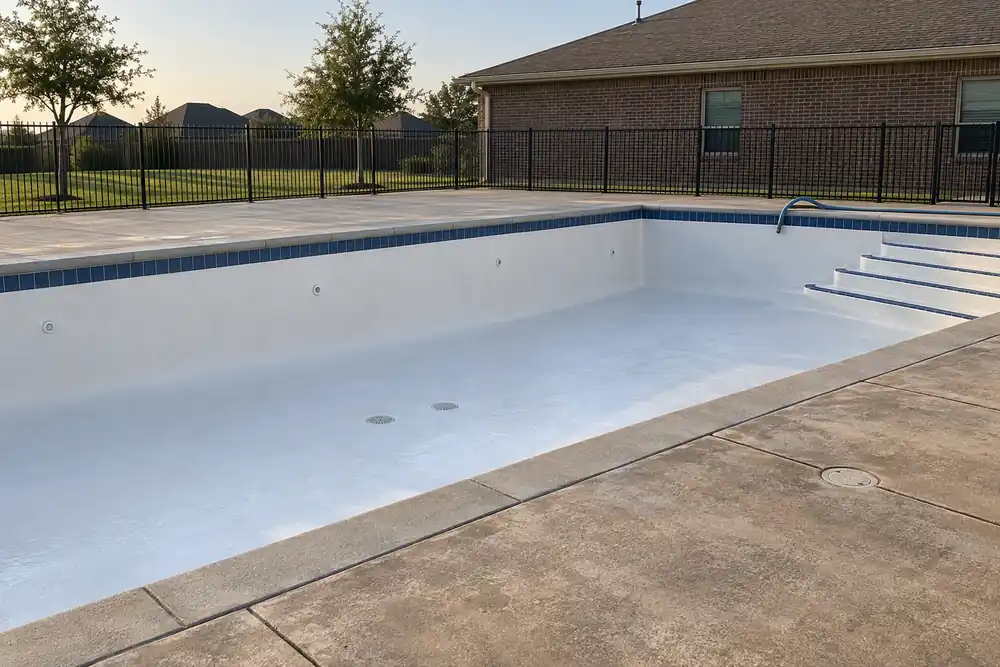
Travertine and Paver Pool Decks in Rockwall, TX
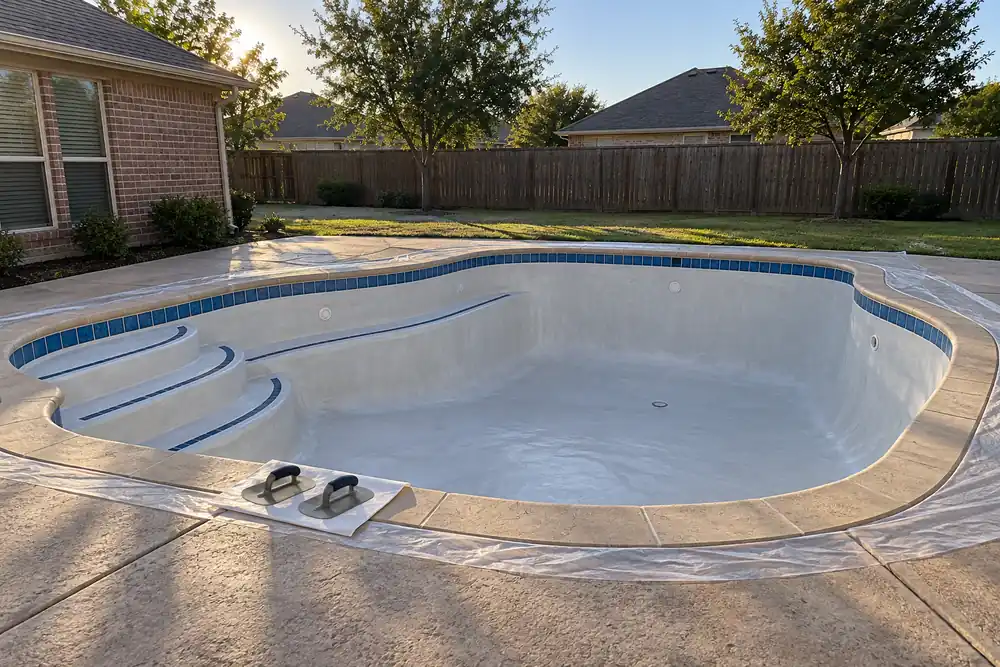
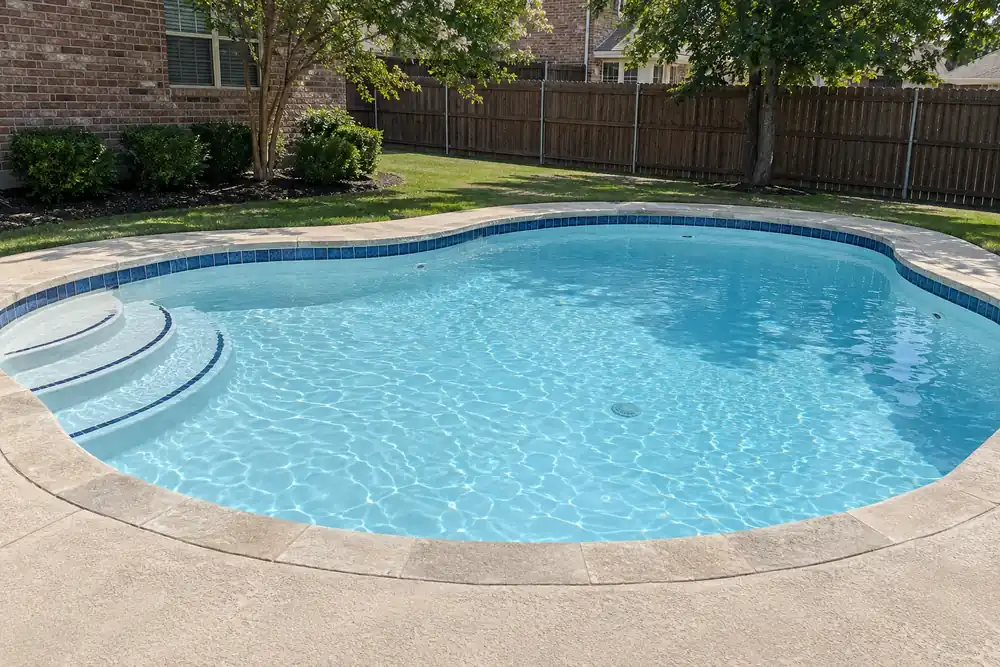
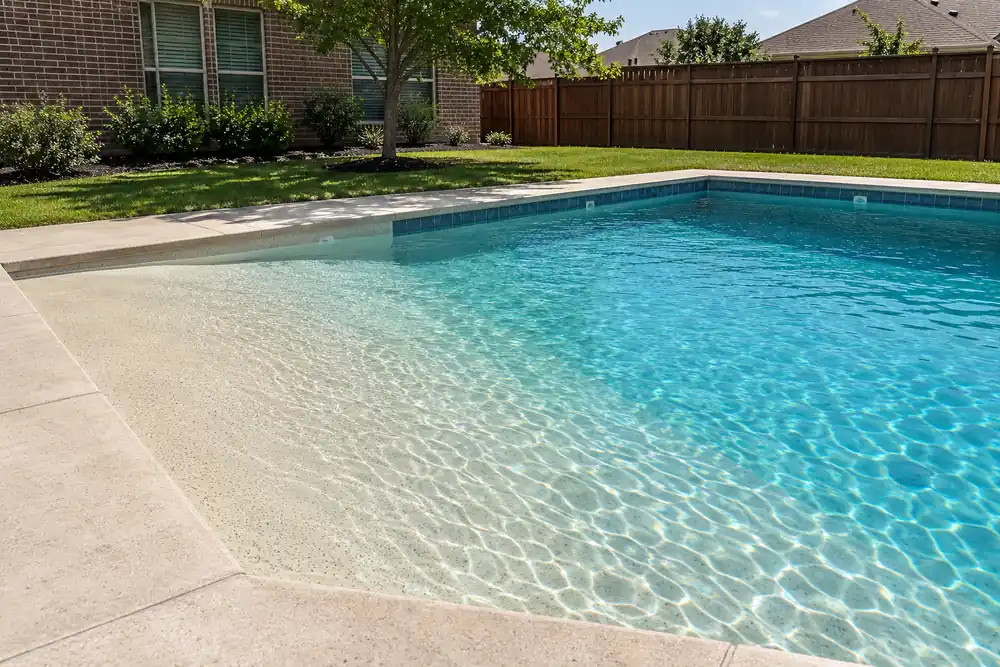
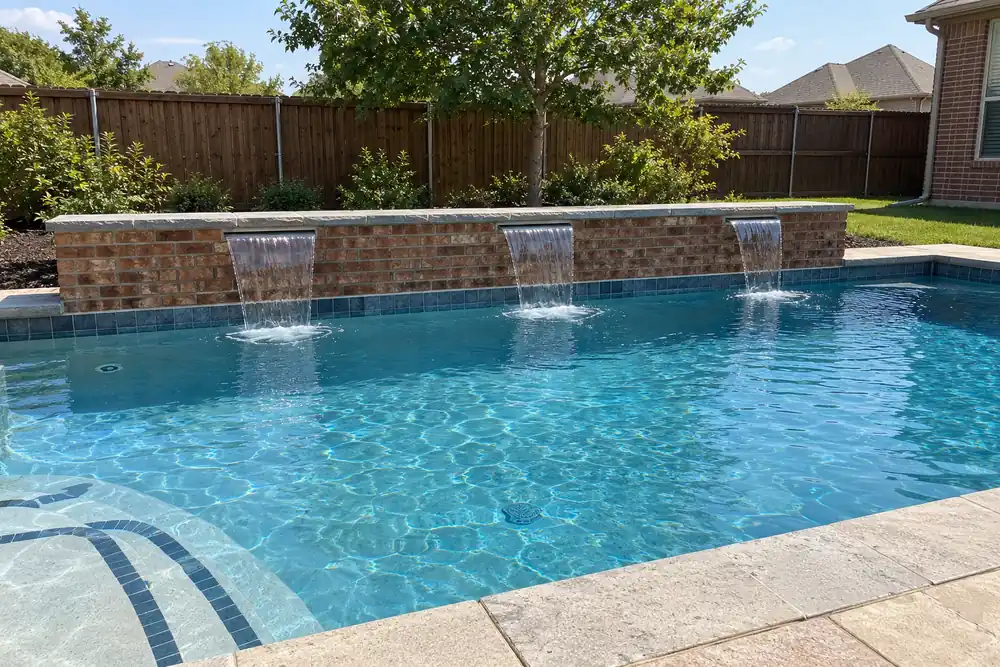
Rockwall Pool Resurfacing builds travertine pool decks and paver pool decks in Rockwall, Texas: natural travertine or manufactured pavers laid on a compacted base around the pool, sloped to drain, with a flexible joint where the deck meets the coping. The Interlocking Concrete Pavement Institute counts high slip resistance and rapid drainage among the reasons pavers make a desirable surface around residential and commercial pools.
Typical Dallas–Fort Worth figures for 2026 put travertine, natural stone pavers, flagstone and stamped concrete at $10 to $30 or more per square foot around a pool. Estimates are free, and we'll talk through the stone, the base under it and the drainage before anything is booked.
Call or request a free estimate any time, 24/7
Get free estimates
No charge · answered 24/7
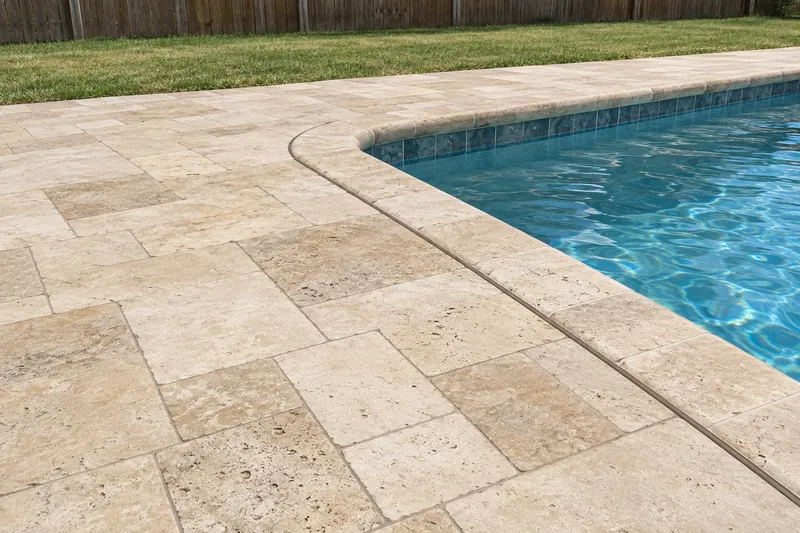
Travertine and paver choices for a pool deck
Two kinds of material go down around pools: natural stone such as travertine, and manufactured pavers in concrete, brick or porcelain. The 2021 International Swimming Pool and Spa Code, which the City of Rockwall has adopted, asks the same of either, a deck surface that is slip resistant and cleanable. A sound concrete deck that only needs a new top layer is a different job, pool deck resurfacing.
Travertine
The Natural Stone Institute says travertine shows more variation than any other natural stone, and that its holes aren't the measure of quality; solid structure and finish work are. It tells buyers to ask for a range of samples before installation and, when the order runs to several pallets, to mix pieces from all of them as the stone is laid.
Concrete, brick and porcelain pavers
Interlocking concrete pavers are laid on sand over a compacted base and held in place by edge restraints, which the Interlocking Concrete Pavement Institute calls essential because they keep the pavers and sand locked together. Concrete poured and pressed to look like stone or brick is a stamped concrete pool deck instead.
Slip and stain resistance
The Natural Stone Institute ties slip resistance to a material's texture and porosity, any surface treatment and what it is exposed to, water and dust included, and says stone paving can be finished for slip resistance. Stone that absorbs less water tends to resist stains better, it adds, and sealing can lower absorption.
Call or request a free estimate any time, 24/7.
(469) 653-0486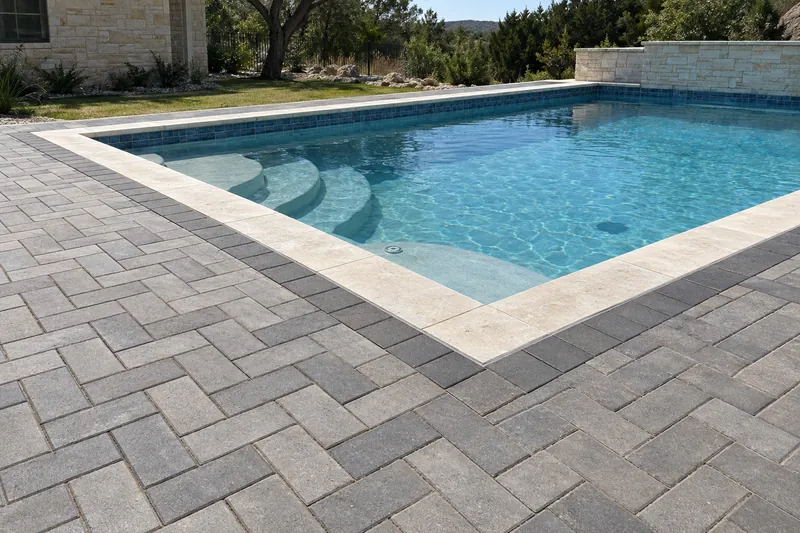
How travertine and pavers are laid around a pool
Sand-set systems are common for exterior paving and mortar-set systems are often used where stability matters, according to the Natural Stone Institute, which warns that even a durable stone can fail if drainage, movement or the base underneath aren't dealt with.
The base and the bedding sand
A concrete base of 4 inches or more is the Interlocking Concrete Pavement Institute's usual answer when the soil backfilled around a pool, or an aggregate base over it, won't compact properly. Its pavers sit on a nominal 1-inch layer of bedding sand graded to ASTM C33, never mason sand, which it calls slow-draining and unstable, and never stone dust. A plate compactor of at least 5,000 lbs force, running at 75 to 100 Hz, goes over the pavers, sand is swept and vibrated into the joints until they're full, and the finished surface sits 1/8 to 1/4 inch above the edges to allow for minor settlement, with no more than 1/8 inch of lippage between neighbouring pavers.
Slope and drainage
For travertine or brick-set pavers, the 2021 code's minimum drainage slope is 1/8 inch per foot around a residential pool, and no deck other than a wood one may slope more than 1/2 inch per foot. The Interlocking Concrete Pavement Institute slopes both the paver surface and its base toward drains with holes or slots at the bedding-sand level, so water held in the sand can get out.
The joint at the coping
Between the last course of pavers and the pool coping, the Institute calls for a urethane or neoprene sealant over a backer rod, so water stays out while the pool wall and the paving move by different amounts. Stone coping chosen to match a travertine deck is set as part of pool coping replacement.
Call or request a free estimate any time, 24/7.
(469) 653-0486Travertine deck care and conditions in Rockwall
Travertine is a calcareous stone, mostly calcium carbonate, so the Natural Stone Institute recommends mild, non-acidic cleaners and warns that products with lemon, vinegar or other acids can dull or etch it.
Cleaning around the pool
In outdoor pool and patio areas the Institute suggests flushing the stone with clear water and using a mild bleach solution for algae or moss. It also warns that high-pressure spray nozzles and stiff brushes can dislodge or wear away the filler in travertine's voids.
Etching, efflorescence and rust
Acid etch marks call for a stone dealer or professional restorer to refinish or repolish the stone; light surface scratches can be buffed with dry 0000 steel wool, but deeper scratches and nicks need a professional. A white powder on new stone is efflorescence, mineral salts carried up by water from below: the Institute says to dust-mop or vacuum it rather than wash it off, and to find and remove the source of the moisture if it keeps coming back. Rust and other metal stains come out only with a poultice, and deep-seated rust may stain the stone for good.
Heat, freezes and permits
The Natural Stone Institute's campaign notes that in hot climates thermal expansion and long sun exposure can affect a stone's color and its movement joints, and that where it freezes, moisture inside the stone can expand and crack it. Lavon Dam, the nearest NOAA station with temperature normals, averages 14.8 days a year at 100°F or above and 94.8 days at 90°F or above (1991–2020). Driveways, patios and decks all appear on the City of Rockwall's list of work that needs a building permit, so ask the City's Building Inspections Department what a stone or paver deck needs before work starts.
Southwest of Rockwall, Sunnyvale's fee schedule lists $200 for a residential deck, patio, porch or cover permit, and Rockwall Pool Resurfacing also handles travertine pool decks in Sunnyvale.
Call or request a free estimate any time, 24/7.
(469) 653-0486Travertine and paver pool deck cost
The stone, the deck's size, the base and any tear-out of old concrete move the price. The Dallas–Fort Worth range above lumps four materials together, so these are typical Texas and national figures for stone and pavers:
- Travertine pool deck, installed, per sq ft (Texas, 2026)
- $12–$25
- Travertine material only, per sq ft (Texas, 2026)
- $3–$7
- Installation labor, per sq ft (Texas, 2026)
- $7–$18
- Site preparation added, per sq ft (Texas, 2026)
- $2–$8
- Concrete pavers installed as a pool deck, per sq ft (national, 2026)
- $12–$45
- Brick pavers, per sq ft (national, 2026)
- $10–$30
Published Texas and national figures. Averages, not quotes from Rockwall Pool Resurfacing.
The Texas figures add that complex layouts, demolition or premium stone can push travertine past $28 per square foot, while preparation covers removing concrete, fixing the drainage slope, unstable soil and uneven ground. Nationally, a natural stone patio laid on the ground beside an inground pool runs $16 to $35 per square foot installed and a paver patio $10 to $17, in 2025 figures. Rockwall Pool Resurfacing measures the deck and prices it free.
Call or request a free estimate any time, 24/7.
(469) 653-0486Travertine pool deck questions and answers
How much does a travertine pool deck cost?
By deck size, typical Texas figures for 2026 put an installed travertine pool deck at $3,600 to $7,500 for 300 square feet, $7,200 to $15,000 for 600 square feet and $12,000 to $25,000 for 1,000 square feet. Rockwall Pool Resurfacing gives a firm price once it has measured the deck and seen what it will sit on.
Is travertine good for a pool deck?
It can be, if the stone and the base suit the site. The Natural Stone Institute describes calcareous stones such as travertine as commonly used indoors or outside where conditions are relatively controlled, and says the limestone varieties with a successful history as exterior paving in freeze-thaw country are relatively limited. In travertine's favor around water, stone paving can be finished for slip resistance, and filling voids as they open is accepted practice.
What is the best stone for pool decks?
No standards body names one best stone. The Natural Stone Institute's campaign sorts paving stone into calcareous stones, such as limestone, marble and travertine, and siliceous stones, such as granite, basalt, quartzite and sandstone, which it calls generally harder and more resistant to abrasion and chemicals. Whatever the stone, the pool code judges the finished deck by whether it is slip resistant and cleanable.
Which is better for pool decks, pavers or concrete?
Each has its case. The Interlocking Concrete Pavement Institute points to pavers' slip resistance and quick drainage around pools, while the National Ready Mixed Concrete Association says it isn't possible to produce completely crack-free concrete, which is why poured decks get planned joints. On price, typical Texas figures for 2026 put installed concrete at $8 to $18 per square foot, travertine at $12 to $25, limestone at $14 to $28 and porcelain pavers at $15 to $30.
Does a travertine pool deck need to be sealed?
Not always. The Natural Stone Institute says stone sealers are really impregnators that act as a repellent: they make stone more stain resistant, not stain proof, and many stones don't need sealing at all. NPT describes two kinds, penetrating sealers that protect without changing the look and enhancing sealers that also darken and enrich the color. For pavers, the Interlocking Concrete Pavement Institute recommends sealing the pavers and joints to keep the sand in place.
Get a free travertine pool deck estimate
Rockwall Pool Resurfacing answers calls and estimate requests 24/7 for travertine and paver pool decks in Rockwall and nearby towns. Tell us roughly how big the deck is and what's under it now.