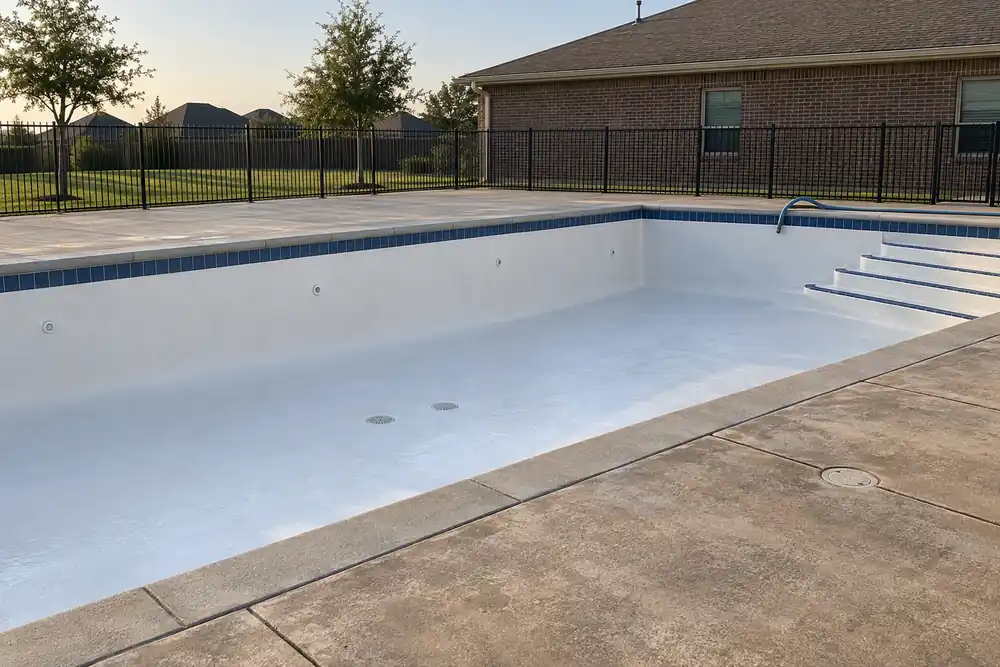
HOA and Apartment Pool Resurfacing in Rockwall, TX
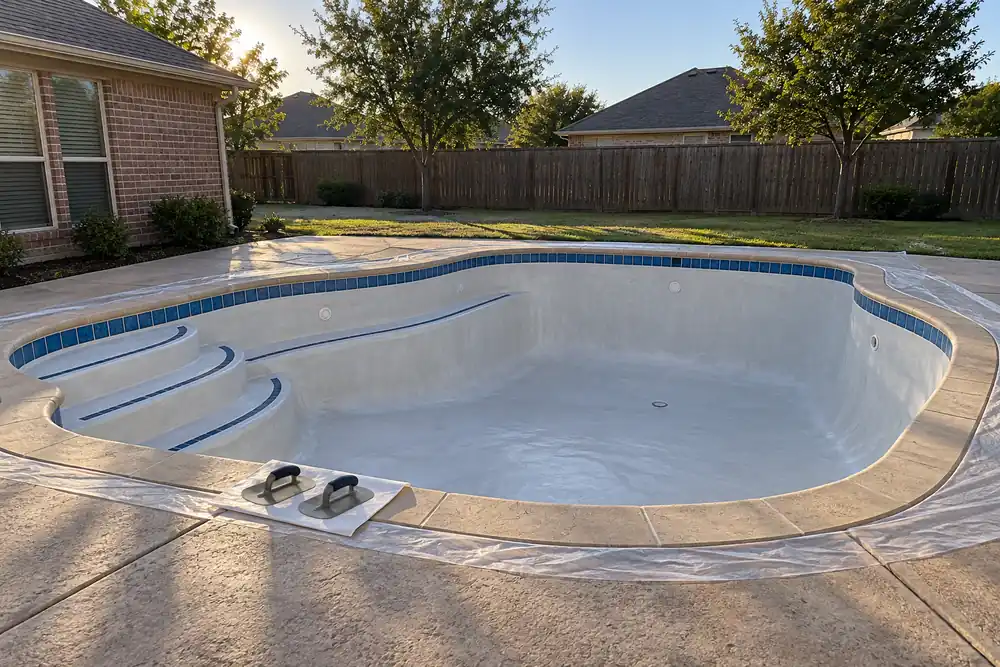
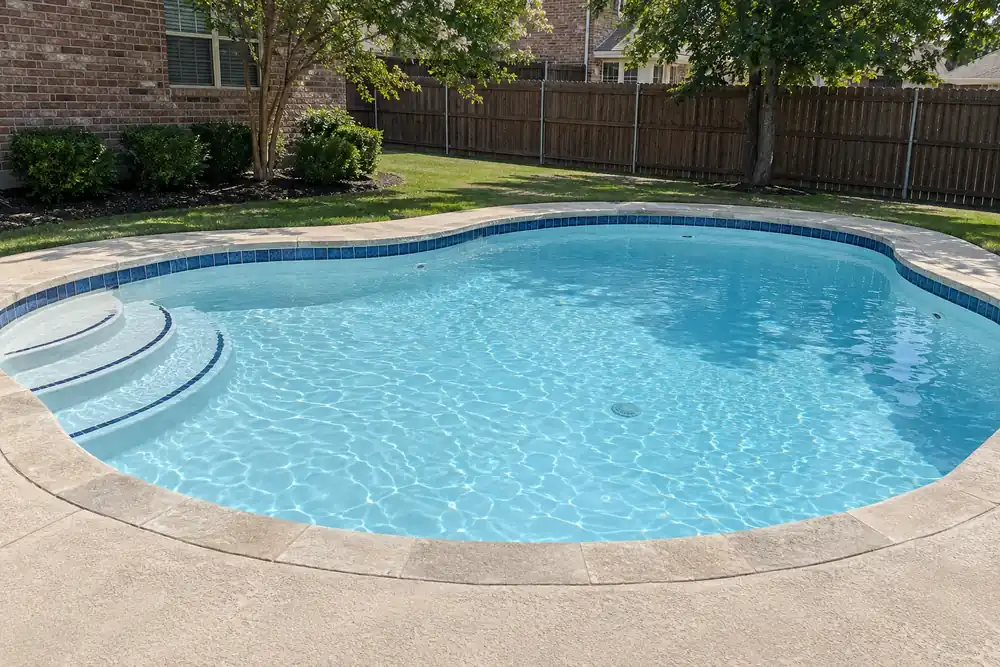
Rockwall Pool Resurfacing handles HOA pool resurfacing in Rockwall, Texas, along with apartment and condominium pools: a new plaster, quartz or pebble finish on the shared pool, with the waterline tile, depth markers and step edges that go with it. The CDC's model code lists apartment complex, condominium and homeowners' association pools as public aquatic facilities, next to community pools and hotel pools, and the Texas public pool rules count a pool run for a property owners association or an apartment complex the same way.
In Rockwall, Texas Department of Licensing and Regulation records list a 1,300-square-foot amenity building and a 300-square-foot pool bathroom building for the Lofland Farms Owners Association at 2400 Wagon Wheel Dr., registered in 2018. Shared pools carry duties a backyard pool doesn't, from the pool yard fence to the operator who looks after the water, and we'll talk through them with the board or the manager along with the price. Estimates are free, and calls are answered 24/7.
Call or request a free estimate any time, 24/7
Get free estimates
No charge · answered 24/7
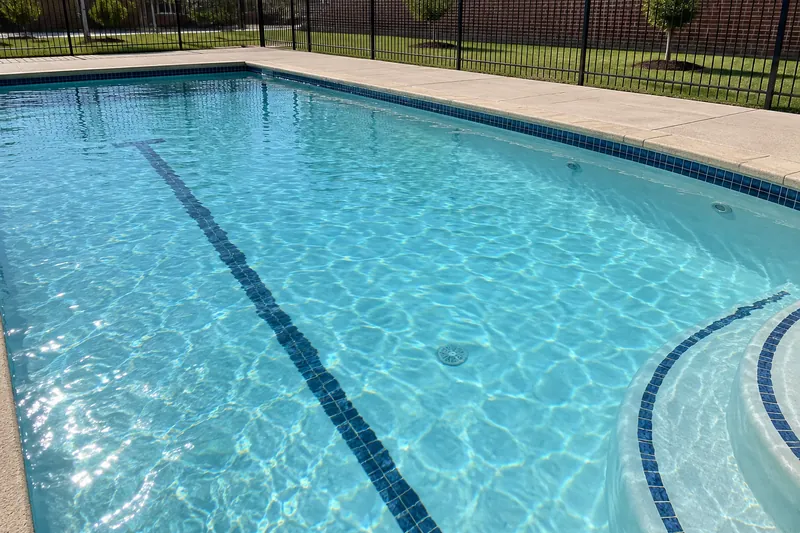
Choosing a finish for an HOA or apartment pool
SGM, the maker of Diamond Brite, says many building and health departments require a commercial pool finish to use a non-pigmented white cement binder with a dry lightness (CIE L) of 80.0 or more and a wet reflectance (CIE Y) of 50.0 or more. In SGM's own tests, Diamond Brite Commercial White reads 88.28 dry and 65.67 wet, a 9 on the Munsell value scale, while its dark Onyx reads 44.54, 7.71 and 2 and sits outside the maker's "Commercial Compliance" group of colors. SGM says the colors in that group, which runs from Commercial White and Ivory to blues such as Super Blue, Cool Blue and Marlin Blue, exceed the CDC model code's 6.5 on the Munsell scale.
Whatever the finish, the National Plasterers Council calls proper water balance the most critical care item for a cement-based pool surface. The page on pool replastering covers how a plaster job runs, from the bond coat to the fill.
Steps, benches and ledges at a community pool
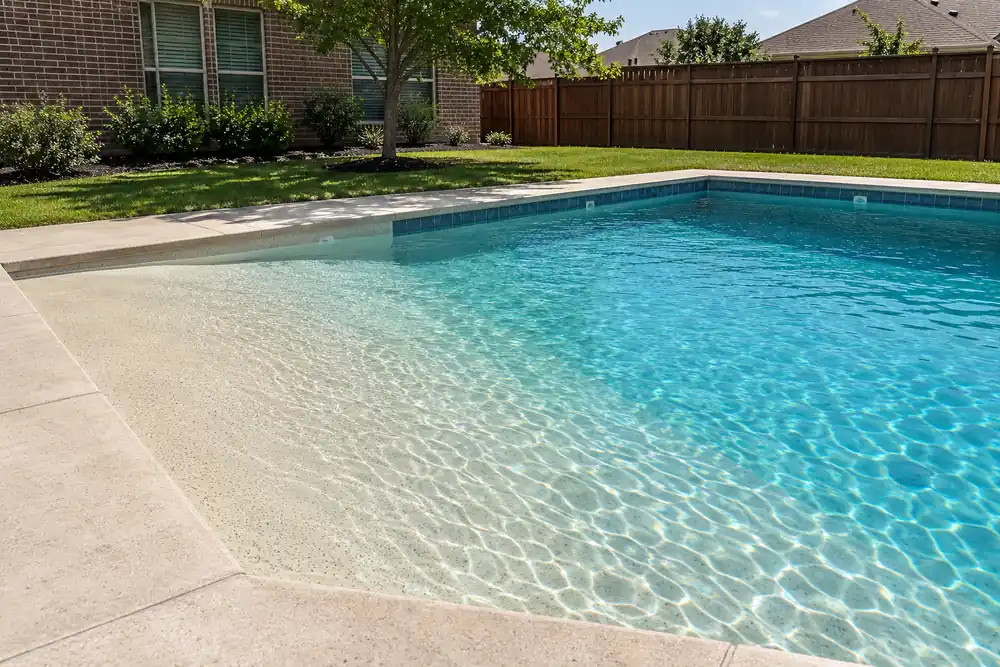
The public-pool chapter of the 2021 International Swimming Pool and Spa Code, which Texas applies to commercial pools, shapes the shallow end more tightly than a backyard pool's. It lets the shallow-area floor slope no more than 1 in 10 at Class C pools, the ones run with hotels, motels, apartments or condominiums, and 1 in 12 at Class B pools. Underwater seats and benches sit no more than 20 inches below the waterline, with a clear surface at least 10 inches deep and 24 inches wide and a leading edge that is visually set apart, and a tanning ledge or sun shelf that serves as the required way in must sit no more than 12 inches deep. Finished step treads and risers have to land within plus or minus ½ inch of the design.
The contrasting edge tile, depth markers and NO DIVING tiles those areas need are covered under commercial pool tile and depth markers.
Call or request a free estimate any time, 24/7.
(469) 653-0486Texas rules that come with an HOA or apartment pool
Two sets of Texas rules reach these pools and no backyard pool: the pool yard enclosure law in Health and Safety Code Chapter 757, and the state health department's public pool rules.
The pool yard enclosure
Chapter 757 covers only pools that an apartment complex or a property owners association owns, controls or maintains. The enclosure must stand at least 48 inches high, measured on the side away from the pool, with no gap underneath that a 4-inch sphere could pass, and chain link has been banned for any new enclosure built after January 1, 1994. Gates must close and latch on their own, take a lock and swing outward, away from the water, with the latch at least 60 inches up, or 42 inches where only a key, card or combination opens the gate from both sides. The owner can't waive the duty to inspect the enclosure, gates and latches at least once every 31 days, and a Texas city that regulates these enclosures by ordinance has to use the same standards.
The operator and the records
The state requires every Class A, B and C pool to run under a trained, certified operator, who doesn't have to be on site while it's open; it accepts the NRPA's Aquatic Facility Operator, the PHTA's Certified Pool Operator and the ASPSA's Licensed Aquatic Facility Technician courses, or an equivalent the local authority approves. The pool must keep, or produce within five business days, paperwork showing every suction outlet meets ANSI/APSP-16. Inside the city, the public pool ordinance Rockwall publishes asks for daily disinfectant, pH and total alkalinity readings and a calcium hardness test recorded once a month.
Call or request a free estimate any time, 24/7.
(469) 653-0486Draining, closing and reopening a community pool
Under the Texas public pool rules, drain and backwash water that isn't reused goes wherever the TCEQ or the local authority allows, never through a hard connection to a sanitary sewer or septic system, and leaves through an air gap at least two pipe diameters above the overflow level of anything that could flood it. It must first be treated, chemically or in settling tanks, to take out chemicals and contaminants over those limits. The refill has to come from a public water system, or a well that meets the rule, with the supply protected by a reduced-pressure backflow preventer or an air gap.
While the pool is closed
The CDC's model code gives an operator four ways to hold a public pool that isn't open: keep the water recirculated and treated, drain it, cover it with a certified safety cover, or restrict access and check the enclosure. Before reopening, the owner or operator confirms the pool meets every criterion again. In Rockwall, the City's operating permit, its fees and its pre-opening inspection apply too, and the page on commercial pool resurfacing sets them out.
South of Rockwall, in unincorporated Kaufman County, the Travis Ranch HOA runs what it calls the community's main swimming pool, and homeowners register household members and guests for pool access. Rockwall Pool Resurfacing also handles HOA pool resurfacing in Travis Ranch.
Call or request a free estimate any time, 24/7.
(469) 653-0486HOA pool resurfacing questions and answers
What are the regulations for private swimming pools in Texas?
A backyard pool answers to its city's code. Texas law makes the International Swimming Pool and Spa Code the municipal pool code across the state and lets each city adopt a newer edition with its own amendments, and the state health department's public pool rules leave out any pool serving only a single-family home or duplex. Rockwall's amendment to its 2021 pool code says the code doesn't override the state's public pool standards or the 2012 Texas Accessibility Standards, and that neither applies to pools serving one- and two-family homes or townhouses. A pool an HOA or apartment complex runs for its residents falls on the public side of that line.
How much does it cost to resurface an HOA pool?
National reserve-planning figures for 2026 put replastering a typical HOA community pool at $8,000 to $25,000, depending on surface area and finish, and suggest setting aside $667 to $3,125 a year toward it. Those are planning ranges for reserve budgets rather than bids, and Rockwall Pool Resurfacing prices your own pool free after a look at its size, finish and condition.
Is there sales tax on resurfacing an HOA or apartment pool in Texas?
Not on the labor, under the Texas Comptroller's rules. A pool an HOA or an apartment complex owns for its homeowners or tenants counts as residential property, and labor to repair, remodel or restore residential property isn't taxable. A hotel pool, or one at any facility subject to the hotel occupancy tax, is nonresidential; there the whole charge for the remodel is taxable, at a combined rate of 8.25% inside the City of Rockwall.
Can residents use the pool while it is being resurfaced?
No. Even on fill day, the National Plasterers Council's start-up card allows no people or pets in the pool. The Pool & Hot Tub Alliance follows the Council's basic 28-day start-up for marble, quartz, pebble and glass-bead finishes and says swimming begins only once the water is balanced and properly sanitized; a finish maker's own instructions may differ.
Do apartment pools follow the same rules as HOA pools in Texas?
Largely, yes. The state's public pool rules put both in Class C, limited to occupants or members and their guests; Chapter 757's enclosure law covers pools an apartment complex or a property owners association owns, controls or maintains; the federal drain-cover law's definition of a public pool takes in pools open only to residents of an apartment complex or a residential development; and the Comptroller treats both as residential for sales tax. A hotel pool is a Class C pool under the state rules as well, but nonresidential for sales tax.
Get a free HOA pool resurfacing estimate
Rockwall Pool Resurfacing answers calls and estimate requests 24/7 for HOA, apartment and condominium pools in Rockwall and nearby towns. Send the pool's size, its current finish and the date residents expect it back.